Metapsychoanalysis, Guy-Claude Burger’s account of the true purpose of love and human instinct, holds that the incoherence and aggression Freud attributed to the Unconscious were never innate to us, but result from sexual repression and the effects of denatured molecules in food. Read this way, our species’ seemingly excessive sexual drive, including its “sterile,” polymorphous forms, points toward what it was actually meant to develop: reliable extrasensory perception and psychokinesis, or in other words, magic. This paradigm shift could found a new science, finally outgrowing materialism. As the film Joy and Joan asked, “After happiness, what is there?” The answer is transcendence, superhumanity.
In natural conditions, instincts revealed to be extraordinary well adjusted, purposeful and coordinated, and only antisocial in so far as our society is harmful and corrupt. Their free expression and the return to our natural state, far from auguring a descent into the individualistic, wanton violence falsely attributed to our animal roots, would be the salvation of mankind and its sole means to exorcize for good wars, sexism, domestic violence, materialism, religious fanaticism, and all the ills that have plagued mankind since before even written history.
More concretely, we are taught that the perfect union involves a man and a woman couple, around the same age, from distant families. We are taught that the natural purpose of love is to create a stable home to raise kids, the next generation, thus perpetuating the species. Yet, despite most of the planet diligently doing just that, the love life of modern people is patently miserable, marked by deception and sexual insatisfaction.
And people of antiquity did not always fare better. In ancient societies -consider the open sexual attitudes of the Greeks and Romans weaving a range of desires into daily life, or the outrageously permissive norms of the Etruscans—family structure and sexual freedom varied dramatically. How much fulfillment or frustration individuals experienced often depended on how closely their societies resembled our own restrictive models, or conversely, how much room they allowed for sexual expression outside the procreative norm.
While some fetishes are considered “natural” evolutionary-driven—such as that of big behinds with big milky boobs—the quintessential degrading maternal regression—other fantasies are deemed marginal and others vilified. Despite a mountain of evidence and scientific consensus, some still deny the naturality of homosexuality, while others claim bisexuality is the default state of life so long as the loss of fitness does not outweight the cost of discrimination under natural selection.
As norms today have become almost the least permissive in all history, anyone can observe the result: Domestic violence, adultery, divorces and the constant objectification in media and sexual misery for both sexes, all that shows that love does not meet our expectations. And as we will see, problems are not strictly exclusive to heterosexuality.
The cause of this moral degeneration becomes apparent, when we notice how in history, it always correlates that of food. The more complex food recipes, the more “chaotic” and disconnected from reality sexual impulses. This situation leads to conflicts and unconscious backlashes named “Excalibur impulses”, normally aimed at reestablishing balance in troubled inter-individual relationships, but in these conditions only result in further unrest and resentment, usually as powerful as unconscious.
For the overwhelming majority of the population, the domination of not heterosexuality, but the basest, crudest form of it with its obsession of coitus, destroys the possibility of sexual satisfaction even on a technical level.
Young males of today have not improved much since the distribution of sexual education, not in the hedonic department at least, for the simple reason they don’t care but merely pay lip service to such a bothersome notion as “reciprocity”. They merely interpret it (partly thanks to said sex ed classes) as the need to titiliate a little bit the three points ( refering to the tits and clit, supposing they ever find it) like a goddamn joystick before shoving it in. And that is it. We may know more about feminine sexuality, at least can access the knowledgee readily, but it bothers us a lot. Cue the myth of the G spot, which only ever served (heterosexual) men.
All manners of statistics show the omnipresence of fake orgasms among heterosexual women, versus homosexual ones. And what better evidence of a monumental failure do we need to reconsider our whole approach ? Women recognize they rarely orgasm at all and never through coitus alone. This elucidates the scientific and popular eagerness of giving into the G spot myth, a sacro-saint place of worship which could magically save vaginal intercourses, the most single-minded and enduring obsession of humanity. Suddenly all the sour but accurate feminist complaints of the 70s and 80s have been promptly invalidated by an elusive spot whose discovery science hasn’t been replicated yet.
After a few decades of painful resurgence thanks to valiant efforts of women in the 70s, men once again could forget about the clitoris. The anatomic sources of pleasure for both sex have never been secret before, if we are to go by written documents: under a millenium of the oppressive yoke of the Catholic Church people were more sexually free, fulfilled and happy than we are, and we know from the ceaseless complaints of priests, more innovative in bed. For instance sodomy might have been viewed as devilish, but was practiced just as much, without any repercussion.
On the other hand, the baffling contemporary disregard for our feminine partners and unwillingness to see the elephant in the room, testifies not only to the ignorance of the much wider wealth of sexual contacts in nature, but also that there must be a common reason for that incompatibility in sex, which all cultures so far have show the signs of.
Information on sex has never been as available as today, yet it is astounding to see that most women do not seek to take care of themselves or maximize pleasure in their life in any meaningful way the way men are inclined to. And the “liberated” heterosexual women that do take care of their orgasms, do not appear much happier or fulfilled in any way that matters. While men fail to keep attraction for a body they drilled into more than a few times. This leads to the multiplication of recipes of sex such as the kama sutra, ever more ridiculous positions and kinks in hope to rekinkle the dying flame, to the grotesque range of sex-toys and degrading exposition of anatomical oddities porn movies are full of.
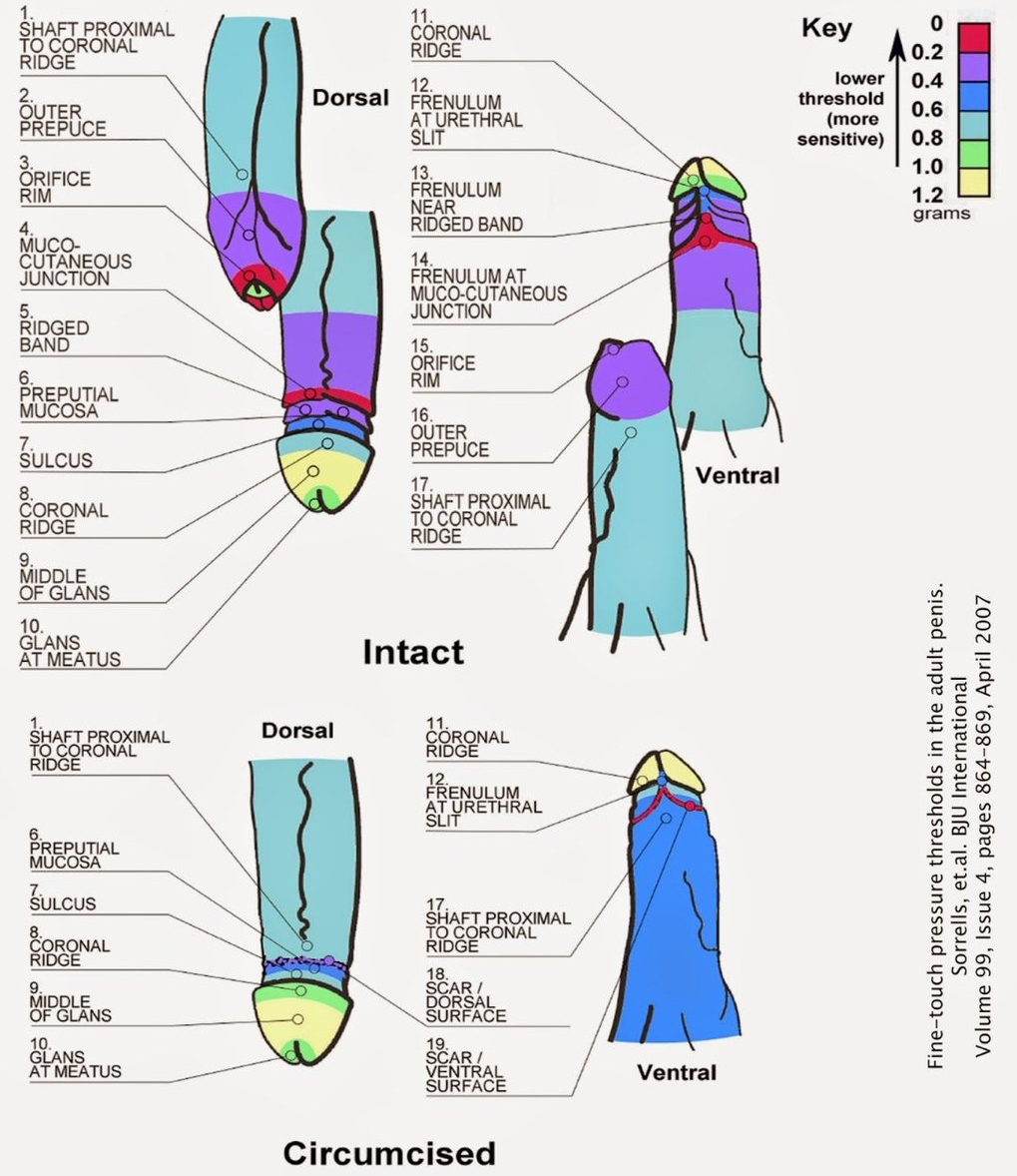
That said, men have been the one to suffer sexually the most due to the biggest frequency of circumcision ever reached before in Europe and Asia since the end of WW2. Jew-like systematic masculine genital mutilation in hospitals at birth (under three days, as per talmudic law) exploded. Circumsion destroys penile sensibility, that has been measured experimentally. The prepuce is the most sensitive, most innerved organ of the male body, and it is ripped off in its entirety, while the glans, getting dry and keratinized (hardening), looses one third of its nerve endings.
We are today in the Darkest Age there ever was, darker than any century past, than the world wars themselves or the plague outbreaks of old, for what is a life worth for one forever robbed of the possibility to enjoy himself as he is meant to ?
Circumcision at birth creates artificial Jews, dead to the world, creatures bound to fall into materialism and coarse sensations if not for some divine saving grace. Jews stand responsible for the introduction of materialism in our civilization, with the grafting of a completely foreign religion that wiped out and drowned in blood our native European spiritual traditions, then warped its memories and interpretation to the point of projecting Christian morality on the past (including but not limited to the puritan hatred for Greco-Roman pederasty and homosexuality).
They introduced the horrific practice of circumcision to Europe as well as their self-hating, sadistic sexual thinking. From the very beginning, the purpose of circumcision has always been explicitely to neuter men spiritually, to reduce them to a state of impotence (“bring about a decrease in sexual intercourse”) and disconnection from the divine to force them to resign and seek refuge in a fake religion because the capacity for real sexual satisfaction is physically removed.
It is also the unforgivable sadistic torture of babies unconsciously hated because they embody the existencial failure of their approach to sexuality. The consequences, as the Talmud says so eloquently, are unfathomable, beyond intellectual understanding, touching the very soul.
*an we not expect more from the most natural instinct of all than self-harm and misery ? Something is missing from sex as we know it, regardless of amount.*Wheither we strive for restraint or indulgence, the same madness ensues, there is no escaping that lack of a certain something in ourselves. A gaping hole in our life.
Our mistake has always been to think reproduction was the “natural” purpose of sexuality and merely diverted for egoistic pleasure, and while in our lineage (and a few others) it has always been the acquisition of a metapsychic energy fuelling psychic abilities.1
Cooking (food processing in general) made this sensibility and connection to a higher order of existence all but disappear, along with polymorphic sexual instincts key to fuel them, inducing a paradoxical and pathological brain wiring from birth. Nowhere better in sexual acts, we observe the overridding capacity of energy, to direct any and all sensations, as sexual feelings and fixations relate the closest to our deeper (meta)psychic structure: choices we do there, most of the time unconsciously, impact our destiny the most.
Cooking directly strengthens baser animal impulses, foremost the impulse to breed, with its coital fantasies and a number of base behavioral traits such as aggressivity and submissivity, in men and women respectively, and while the issue of jealousy is a multilayered one, it comes down at its core to the same instinctual mishap, explaining why only 3-5% of all species of mammals that are monogamous, and hardly any of them actually live in truly “faithful” couples while it has been praised as an ideal in so much unrelated places. It explains the quasi-universal male fixation on secondary sexual characteristics most symbolic of fertility, meaning big boobs and fat ass.
We become used to these unnatural urges, for men to fuck and for women have babies, creating whole personalities we think genuine yet inherently pathological, which repression and sublimation make worse. And to this day, since the start of cooking, all cultures and societies bar none have catered to the need of such personalities, and reflected this pathology to bigger or lesser degree.
The range of our possible attractions is channeled by hardwired trigerring patterns, determining the situations and relational constellations we innately see as promiseful regards to energy. These complexes of instincts we call triggering patterns may belond either to the reproductive instinctive program, or to the metapsychic instinctive program.
As opposed to the reproductive instinctive program (RIP) responding to gross biological impulses and unchanging hereditary qualities, the metasexual program on the other hand revolves around the feeling of “inner beauty”, purity, innocence and similar concepts. As such perception of a person, contact or context can switch from appealing to appalling in an instant depending on subtle cues or thoughts alone. With endogenous excitations from cooking these subtle functions can not reach their goal and express themselves imperfectly, explaining the mysterious “erectile dysfunctions” in men and frigidity and inorgasmia in women.
According to statistics, 92% of the population at large describes its sexuality as “normal”: simple “normal” heterosexuality with unrelated strangers. While the norm for all most intelligent mammals is 100% of bisexuals and 70% of homosexual contacts, and very liberal incest. This planetary-scaled discrepancy can only be explained with the forceful rerouting of all polymorphic urges and libido into breeding behaviors.
Primitives often display a keener, more rational understanding of the extrasensory than the civilized man (Western or Eastern). It would be foolish to assume they used the supernatural as a clutch to supplement their feeble intellect.
This energy is known under many names such as the Christians’ charisma, Chinese’ ki or the Melanesians’ mana, and the symbols it carries2 fits Plato’s and Jung’s descriptions of Archetypes perfectly3: we do not own or possess it, rather we are freely bestowed it by a higher power if we follow natural laws. This higher power, some call God, or the sentience of the universe. It is the place of origination and dwelling of all souls, outside of time and space. Arabs named it the Alam-al-Mithal, the pre-islamic Persans the invisible world, Platon the world of archetypes or Essences (“that which exists in and of itself”). Its messages come with an inherent limiter, a sort of cosmic circuit breaker forbidding its use for “evil”, what goes against the natural order, making “black magic” a contradiction in terms.
Speaking strictly from personal experience, the first and most potent ability restoration of the original diet and metasexual program grants nearly automatically, are precognitive visions of the past and future offering a direct access to a near infinite field of information in proportion to one’s spiritual energy and inner purity.
This usually takes on a visual form (as we are mostly visual animals) but can at times employ about any sensory field whatsoever, from hearing to touch and smell or direct ideation (foreign ideas and understanding arising out of thin air). The entire gamut of perception can operate on this level.
Metapsychoanalysis resulted from decades of observations4 delineating the boundaries of natural sexuality, delineating the behaviors genetically most conducive to an ever-expanding feeling of elation along with a pleasure far outclassing sexuality limited to its organic component. But most importantly, most conducive to magic.
Relations outside today’s normality were thought as a source of hidden powers all over the world, either praised as angelic or condemned as diabolical. Ancient Egypt, Rome, and all over the world, unrestricted, “taboo” sexuality has always been the key to extraordinary abilities and achievements. Still today, the proportion of homosexuals or polygamists of all kinds among artists (music, cinema, fashion designers) far exceeds that of the ordinary public. Lastly, specialists in parapsychology know for a fact that “child molestation” nearly always features in the childhood of “gifted subjects” (mediums).
Let us define precisely what the exact breadt of natural sexuality, by looking into animal exemples.
Genital contacts between same-sex individuals for pleasure has been observed in more than 51 non-human primate species, while enduring same-sex couples are common in macaques, orangu-tans, bonobos for which 65% of sexual contacts are lesbian, gorillas and chimpanzees. Gorillas which live either in male-only groups or harems of one or a few males with many females also exhibit homosexual activity culminating with orgasms like ours. Chimpanzees, the second closest apes don’t feature nearly as much sexual proclivity in general but contrary to what has been believed for a long time their sociosexual behaviors do include a similar frequency of homosexual contacts, observed for all ages and genders, with—not to our surprise—a marked preference for age-gaps.
More general attempts at recontextualizing described those behaviors not just as adaptive idiosyncrasies of a few species but as a pervasive evolutionary tendency have been undertaken since then. This extensive bonds-creating property of homosexuality was noticed and commented upon again and again in history, among the latest and best expounder being Adolf Brand, publishing the Eigene from 1896 to 1933. At a time where degeneracy reigned supreme and what would become the LGBTI religion (from transsexualism and faggotry united as one started representing all homosexuals, granting themselves an undue right which quite frankly played in the reactionaries’ hand, eager to demonize everyone in the name of God or what stood for it.
The exact same behaviors have been observed for decades in chimpanzees as those we acknowledged readily (relatively speaking) with bonobos, Jane Goodall herself explicitely refused to qualify them as homosexual or sexual at all5, as she wrote herself, arguing that because there is no intromission (penetration), mountings and thrusts could not possibly be sexual. Despite the orgasms.
As if intromission was necessary for any kind of intercourse, homo or hetero ! Yet this is the base of reasoning most commonly found, at least until recently. This systemic schizophrenia, is no better than denying the intrinsic erotic component of breastfeeding, leading to sexual arousal and climaxing. The fact that many of these African sites’ countries criminalize homosexuality, must have curtailed research, lest for researchers go to prison and their funds removed.
Worse, we should remember that chimpanzees are stil heavily hunted with not a lot of effort invested in their defense. There was the real risk for that small protection to go out the window if those countries were to see apes as pederastic perverts. Their hilarious reaction to gay lions proves it, invoking evil spirits and contamination (of the lions) by Western homosexuals.
Extensive summaries of all species reported so far to feature homosexual relationships have been compiled, for those eager to verify our claims, and maybe put them to some use. While this last article does try to explain the very existence of such behaviors rather convincingly (basically, telling sexes apart would not necessarily be easy and it’s often more efficient to amp up sex drive overall than improve female recognition skills), but the theory falls on its head when we realize olfactive cues is the oldest, most universal means for sex detection in even the simplest of species, or especially, the simplest.
Nor can this explain why sterile amorous behaviors outright prevail in nearly all highly intelligent species like chimpanzees, gorillas, us, and dolphins, species which, none of which (we must stress) living in a carefree, stress-free environment whatsoever. Predators and dangers abound, making the idea of natural selection weakening pretty damn retarded.
Though less frequent in animals than in humans for anatomical reasons, sodomy does not seem exceptional to many apes and monkeys, in the homosexual as well as heterosexual context, with the finger and penis. At the very least we observed that it is not painful for either side, and given that no coercition was recorded, it is most likely pleasurable too. Penetration during mounting might happen on occasion with lions too, leading to… adverse reactions. But researchers could hardly verify in situ, no one volunteering to become cat food for science. And such spontaneous behavior just does lend itself to the controlled conditions of an in-depth anatomical inspection. And choosing to interpret something as a defensive reaction over a play behavior seems awfully subjective to me.
This solely metasexual contact would fit with higher, pro-social species, but even lower species not known for their compassionate social behavior—male lions routinely kill others’ cubs—or no social behavior (polecats) are known for sodomy.
The anatomical disparity between bonobos and humans quite significant: the sexual dimorphy is lesser so compared to chimpanzees males are relatively smaller and females taller, while penises are smaller and clitoris huge, so much so that clitoral penetration has been observed… But sodomy is mostly impossible to them, the most frequent contact being genital-genital rubbing (dry humping or tribadism for lesbians, while it lacks a name with one or two males). Yet male homosexuals are unanimous as to what contact provides the stronger pleasure, by miles: passive sodomy.
What can we conclude ?
It seems evident that the more our intellect increased, the more capable to feel energy, internalize it and metabolize it… at least we should.
It is also a safe assumption that the development of our most important instinctive drive and distinctive feature as a species must have left a noticeable anatomical imprint. - The most obvious anatomical change associated relative to sexuality (beside brain size) is our perfect ability for passive sodomy.
The natural mucous secreation from the anal calnal is dismissed as insufficient to enact penetration. And the same sentiment is echoed nearly universally, from progressists and conservatists alike. People who unlocked it fully, be them men or women, lubricate very quickly and profusely.
Yet a distinct anal lubrication does exist. Whether those secretions come from the rectal mucosa responsible for the bulk of lubrication in defecation or from the specialized glands exist called anal glands repurposed in the evolution of metasexuality these last millions of years, we do not know. Regardless, in good conditions someone can excrete enough fluid to visibly grease buttocks, with very little timulation, making even saliva unnecessary.
Then why does it work so rarely in society even among homosexuals ?
It appears, the only reason vaginas lubricate more easily today is because this part of physiology is (obviously) tied to the same base breeding instincts cooking amplifies. For the same reason most women are excessively fertile on a physiological and hormonal level, they also lubricate too easily, as an automatic response to a situation evocative of breeding, or just as a default state for the body.
In fact of the three sources of useful lubrification that can produce abundant amounts, science only recognizes one, the coat of Cowper’s fluid penises can secrete (aka, precum). But beside anal lubrication proper there is also a very distinct kind of very viscous, extremely lubricating sexual saliva.
But the metasexual program directing all three makes these functions much more subtle and sensible to psychological and nervous disruption, thus heavily hampered with our food and deeply antisexual culture.
Freud and his school described anal sensibility as prominent in children between 0 and 4 (or 6) years old, and not too long ago in Europe (still in a number of less developped South-East Asian countries) mothers routinely caressed babies’ anus with her fingers and tongue. Understandably this is unthinkable for modern consciences…
One can restore this function later in life, but with difficulty without raw food.
Another common argument against sodomy is the allegued “bad smell” or “uncleanliness” leveled against sodomy, seems to have a bit more truth to it, but doesn’t really stand up to close scrutiny either. Bad smells from feces do not exist in nature: wild animals’ stools do not smell at all and those of instincto babies neither. Healthy rectums are self-cleaning. Those odors come from systematically bad digestive processes, which otherwise would be as transparent as any organ in the body we are not supposed to think about nor can control consciously.
Elimination of denatured molecules in instincto and/or consecutively to viral episodes, also induces the expulsion of such “fragrant bouquets”: what goes in by error, goes out by design, or we wouldn’t live nearly as long as we do… It also means different persons will stink more or less depending on their diet and overall health. Different cultures or the same at different points in time will vary for the same reasons, as per all pathological processes.
Nevertheless coprologic “accidents”, even without raw food, are as rare as easy to avoid. Fixating on bad smells more often symbolizes a inner disgust of anality, masking unconscious irrational motives rather than a real aesthetic or hygiene issue. Beside, many vaginas also famously smell bad, yet we rarely bring this up as an argument against heterosexuality.
Contrary to many opinions, it does not seem passive sodomy is much different in men and women, not when it appears liberated women describe sodomy in pretty much the same way as do gay men, with the hallmark global all-encompassing pleasure waves of orgasms.
Assymetries in development always find evolutive explanation from the constraints of the preexisting system coopted for a new purpose or used a template, on the psychological level with instincts and doubly with anatomy. And of all sexual recently evolved sexual functions, beside paying lip service to penetration anatomically sodomy does not relate at all to the old reproductive, coital apparatus: it evolved in near isolation, making a different development in men and women extremely unlikely.
Then how to explain all this speel about the role of the prostate in gay anal orgasms ? Well how anal sensibility works nervously still eludes specialists, as a nervous connection to the prostate in men has not been demonstrated, just assumed. Nevertheless the anus is packed with nerves, including the pudendal nerve connected to the clitoris in females.
As a matter of fact a third of women practicing anal sex relate that experience of an extremely powerful, long-lasting orgasm experience. Men just do not have the monopoly on anal orgasms. Sodomy in girls simply stimulates their clitoris, and gender differences have been overstated in order to justify the role of coitus.
Incidentally, it is a well-known fact phallic stimulation empowers anal sensibility and the other way around, thus logic implies they derive from the same unique local orgasmic system, despite the mainstream not acknowleding it. Ergo the gay emphasis on the passive role likely to derive from overcompensation of this undeniably energetically critical function. So rather than the phallic stimulation being intrinsically inferior to anal passivity, it is more likely that despite being the only thing known by most men, its sensibility has also been cruelly underdevelopped since early childhood.
Because of this evolutionary histo we do not actually believe passive sodomy is the end-all-be-all of pleasure, as gays claim. Moreover, the rehabilitation of metasexuality with a lot of patience and care, reveals a surprising symmetry of sensibility, the possibility for instance of an overpowering sympathetic pleasure on the active side in fellatio. On logical grounds alone, well-balanced instincts should reward and incentivize both roles in relatively equal measures.
When it comes to historical evidences of homosexuality, the absence of homophobic punishment should be considered at minima evidence of the freedom to have homosexual relationships. But on the other hand, anyone familiar the Maghreb or medieval history would say remark, that the presence of anti-homophobic laws is the evidence of nothing, if not a mildly negative general sentiment of some sort, in some regard, by some parts of the population, which still indulge in sodomy or whatever else anyway. One has to attest to prosecutions and execution of sentences, to prove anything. Today, a law is only worth its application, however casual. We should use common sense and not accuse people of horrible things without factual evidence.
Let us take two exemples:
The Sassanid Persians and the Jews, both sharing a properly metaphysical abhorrence for sodomy (either hetero—“incomplete” sodomy—or homo). In the first case erected as the evil cosmological opposite of swedodah, incest, equally powerful but in the service of Ahriman (their Satan). Unlike any other crime it destroys the soul entirely, so unlike for any other crime anyone bearing witness of the act was to behead or disemboy the culprits immediately, without judgment.
In the Ardā Wīrāz-nāmag, in the “crimes against the soul” sodomy lies next to “A woman lamenting and weeping, having a sharp tongue, quarrelling with her husband, beautifying herself and refusing intercourse” as deserving of abominable torture in hell. Now, the explicit purpose of the justice system in Persian society, as it was in Christian society, was to recover social concorde, and help those meant to suffer in hell for their sins, by punishing them in this life, henceforth clearing their slate—as well as that of the community, which always share in good deeds and sins.
Taking this literally—the idea that women really were seriously and mercilessly beaten up for speaking their mind or the slightest use of makeup or not being in the mood of having sex—is closer to mental retardation than correct historical method. This harsh severity even Luther would have objected to was used by Muslim apologists to claim Persia had invented burkas and hijabs and enslaved women before Islam. But thousands of naked and half-naked representations of women were found, in beautiful and sexy settings.
For Jews we know for a fact that the Leviticus ceased to be applied at least 2000 years—before we lack documentation—with the rise of talmudic (or rabinic) judaism. Despite a relative wealth of documents, and the rather cruel, trigger-happy kind of justice they had, there is no account of capital punishment for sodomy in all of Jewish history… But the technical impossibility of proving that crime (requiring eye witness of the sexual act) effectively ensured a perpetual bailout mechanism for any culprit. Evidences for capital punishment being meted out for homosexuality according to Jewish laws is scant, and absent in 250 years of Sassanid history, something which shouldn’t surprise anyone with a slight knowledge of Greek sources.
Similarly, the repression of sexual relationships with children around or before puberty, let alone after, is a relative novelty in history. The notion of statutory rape was extremely uncommon, and when it existed did not ban all vertical sex accross the board and in any situation, but rather ensured the right of parents to choose who they accepted as partners for their children.
First of all, we recuse the modern notion of consent. Even animals express well enough their joy or discontent, and infantilizing children does much harm for their current immaturity. As Tony Duvert said, there are infinitely more parents that who martyrise their children than pederasts who slit the throat of their boy lovers or young mistresses6. A claim easily verified when looking at prison records: the overwhelming majority of pedophiles in jail for statutory rape do not violent their “victim” at all.
Today more often that not rapes on adult women are much more violent, bloody unforgivable and fueled by resentment, quite rightfully as women’s rights lobbies are responsible for the loss of much of the sexual freedom, with children in particular, that existed until the 1990s. Migrants are yet another case, subhuman filth who would not get sex any other way even in the most accepting of places.
Similarly there are many more husbands beating and killing their wife than pedophiles killing their little lovers. Yet it does not seem to matter for society, so singling out pedophilia as this indicible horror, equal only to incest ? Because it is powerful, virile, undermining the very roots of this repressive society.
In practice, pedophilia does not necessitate—and statistically does not involve—penetrative contact at ages we usually think as dangerous. Most pedophiles do not penetrate. Ethnography, ethography (animal behaviours), ancient history, all show the eagerness of children from birth to engage in erotic play with older people78, seeking various touchings according to their age. This thus can not, in and of itself, harm them either psychologically or physically. Modern psychiatric works corroborate those statements words for words:
Even then, there is the underlying assumption we already debunked, that prepubescent children are hurt by contacts physiologically normal for adults because the purpose of sex is reproduction, while it is not. Vaginal coitus itself may be pleasurable and spontaneous from age 8 judging from modern and historical accounts alike, hinting at a dual function both reproductive and energetic.
The assumption that children involved in incest are passive, unwilling victims is an oversimplification of a complex situation. Young children may find such relationships gratifying and, when exposed over time to intense genital and extragenital stimulation, they often become highly erotic. This hypermature responsiveness may be viewed as learned behavior; the behavior is self-reinforcing and nay be difficult to modify. The author describes three children to illustrate their arousal, inability to differentiate sensual from affectionate touch, early gender discrimination, and stereotyped role modeling.
In no uncertain terms, that means children crave for pleasure, for attention, for love, and when given but a modicum of satisfaction, rediscover all on their own natural values Socrate would certainly have shared. Friendship, affection, romantic love, all is one in energy. Only downside, often these children often display so-called “hypersexuality”. Often but not always they got their experience in families not well integrated to society. As often we see the clinical morons and the initiated arriving at the same conclusion in rejecting the mainstream in favor of a more instinctive conduct… the later because they understand and know better, the former because they are too stupid to be receptive to it in the first place. Whether by instinct or thinking with integrity ora bit of both, some people have always see through the lies of the system and embrace what little of their natural instincts remained.
So this early sexualization not being in of itself pathogenic, we should not expect these children to all be mentally challenged, hopeless idiots with a bleak future.
On closer examination, it was discovered that the unemployed father had had repeated oral, anal, and genital intercourse with all four children; however, Venus was his favorite.
She would masturabte for 2.5 or 3 hours, until the bed would come apart.
The school complained that Venus needed constant supervision in class because she liked to teach the boys “nasties”. There was scant supervision on the school bus, so Venus would crouch beneath the seats in back, moving boy to boy. During the psychiatric well dressed and enjoyed speaking with the examiner. She could think of nothing more pleasurable or attractive than doing her “nasties”.
Such children are easily aroused by a variety of circumstances and most often cannot discrminate erotic from nonerotic relationships and most often cannot discriminate erotic from nonerotic relationships. They are readily orgasmic and most often can maintain a high level of arousal without orgasm.
However, the consensus among child psychiatrists is that factors related to the makeup than the sexual behavior of the incestuous are the most family pathogenic rather.
Ibid
In plain terms, before the 1990s specialists used to confess without too much drama, that child sexuality (including with adults, and penetration, and whatever else) was usually not a problem in and of itself, the real problem being that such children, especially when initiated very young, could not bent anymore in order to accept normal, non-sexual social relationships. And why should they ? Why put up with society when they have the fun of their life, more genuine fun in a week than any of us have in a month if not a year ?
The depression and “self-defeating” behavior often related, also comes as no surprise. The little wild wolves rightfully recuse the house-broken, enslaved dog’s collar.
Granted… 3h is a excessive, but comes with a lack of energy. Partners of higher quality would satiate children much better, allowing them to funnel their enthusiasm into culturally-productive activities, but this time from the bottom of their heart, not as lame substitutes for the real object of desire.
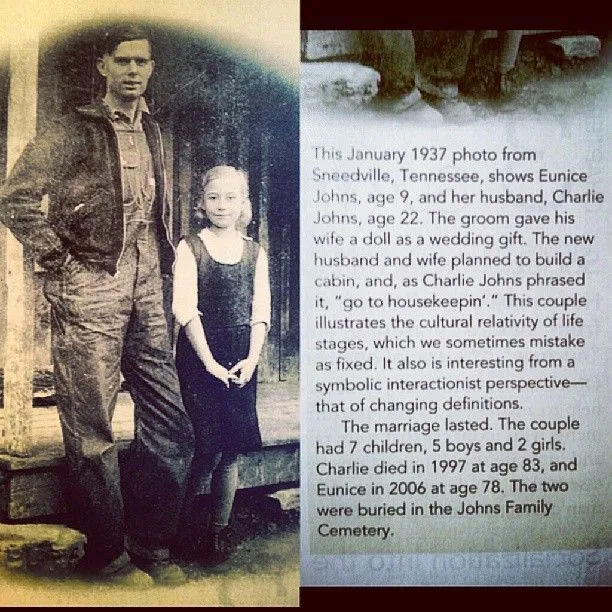
Early XXth child-brides, matches made in heaven
A very suspicious add
A century of clinical psychology and the personal testimonies of both “abusers” and consenting victims, most keeping from a positive to a delighted memory and living productive lives with no discernable trauma of any kind. Attraction to younger people (not necessarily prepubescent ones) mirror that to much older people: they are the opposite sides of a same coin.
Pedophilia or pederasty not only is not hurtful if handled correctly, but it bears the programmed role to ensure a proper emotional and spiritual course of development. Pederasty encompasses both the love of young girls and young boys, as was well attested historically9.
Today young people are neglected and condemned to at least a decade of emotional and hedonic misery, many even, especially girls, do not even learn to touch themselves. To know how to reach pleasure reliably should be an elementary right on par with having food and a roof on top of our head. Without this knowledge, one resigns themselves to a miserable fate within the confines of a marital relationship.
To perform ony task requiring intuition, understanding and concentrated efforts, in general to learn and grow, we need energy. While adults can go on like a well-oiled robot and perform routine work without thinking, truly outstanding work as well as any learning (to be efficient), demand energy, and relates consciously or not to our psychic potential. Especially running counter already established lines of thinking, renewing oneself, is cognitivitely costly, and the hallmark of divine inspiration.
Important precisions
Despite the above, we vehemently oppose breaking the law for a simple reason: a child talking positively about his or her experience will be labeled as a pervert. In the course of days or years, most children will lie to themselves, distorting their memories to fit the social narrative, lest for risking punishment going from social isolation to legal punishment or outright murder10.
People abhor the idea of having sex with children because they themselves live love on an utterly uninspired material or “carnal” level missing the purpose of their existence, and by default project their own wretchedness on all relationships. Although we must stress, the number of actually violent pedophilic rapes are an extreme minority.
That is why children in particular, to become true adults, need a blossoming sexuality, to fulfil their potential. Japanese until twenty to thirty years or so, used to bathe with their opposite sex parent, usually until 15, or limitlessly. Mixed bathing in onsen was normal until feminists and Western influence exorcised it out, and until recently fathers and daughters routinely bathed together. Before the defeat and even more before industrialization, full-blown incest commonly occurred everywhere.
In the past, neither virility or sexual proactiveness were thought as unique to boys or adults. Spartan kids could express themselves fully, their needs meet by adults’ demands in a manner commensurate with their capacities. Textual evidence abound regarding the free access to love to all ages and the generalization of sodomy including for young girls (Life of Lykourgos).
It was not uncommon historically for attraction to be defined rather by the kind of younger lover, irrespective of the adult: for instance, in Japan nanshoku, pederasty, concerned both adult men and women, both vying for young boys. Conversely, famously Spartans did young girls and boys “the same way”. If the spirit of boyhood is there—if the adult woman has natural, metasexual virility in her—age is transcendended too, ending the gender war.
Simon Peter said to him, “Let Mary leave us, for women are not worthy of life.” Jesus said, “I myself shall lead her in order to make her male, so that she too may become a living spirit resembling you males. For every woman who will make herself male will enter the kingdom of heaven.”
Logion 114, Gospel of Thomas
The preference (not exclusivity) for youth comes from the fact youth symbolizes energetic receptivity. The essence of pederasty alike lies not in election or specific partners but in the objective gap in experience or potential, either mundane or metapsychic meant to be crossed11, thus producing pleasure, energy and bonds. Strictly speaking it comes with somewhat of a lifespan until they transform in an adult relationship of a different nature, then it is the young person’s turn to provide the same guidance to still younger people. But if active (sexual) relationships might last months or years, they might persist despite the transformation into something closer to friendship.
Because we do not only feel for youth, we also feel for authentic virility wherever it is, men or women. And that appreciation remains as we age, allowing for equally inspired horizontale, virile homosexual or heterosexual love alike, although of a kind now very uncommon.
How men and women love often mirrors their paternal or maternal instincts respectively, having a preference respectively for hierarchical relationships, a call back to earlier male territorial instincts, on the other hand unweaned infants and younger women, with which women forge relatively egalitarian bonds. In the end however, in love we are all humans with superficial differences.
Though not every pedophile is exclusive, this attraction has a characteristic may repel good consciences and which no sexual minority really shares: children cease to be children after puberty. They most of the time loose their metasexual beauty, with no fault of their own.
One cannot deny the physical, aesthetic and psychological upheaval brought by puberty. Very few go through that ordeal unscathed, defiled by an endocrine cataclysm not found in any other animal.
But we do not believe this state of affairs is natural with all his associated milestones (menstruations, growth s purt, sudden voice transformation, ridiculous facial alteration, inflating breasts and fattening) is an abberation brought by an ever worsening diet. In the past still fairly recently, children a long, smooth change from childhood to adulthood. Adolescence as we know it did not exist.
It makes sense then, that they very short window of opportunity left to us today for love on that level to take place and initiate young people spiritualy is much shorter than it ought not such a long time ago: 5 years instead of 10 or 15. To that, we can add the reigning frustration and abnormal excitation, to explain the irrepressible compulsion some pedophiles demonstrate.
This notion was developped independently by the site’s author.
This incestuous drive functions very differently from the pederastic complex, and the erotic attraction may last potentially last for the whole life because unlike pederasty, it does not depend on the recognition of age and beauty, both transient characteristics like age or beauty, sometimes even overturning established sexual orientations. The existence of common blood brings about a particular kind of magic which sees our relatives suddenly glowing in our eyes and thoughts, removing their flaws moral or physical from our mind, and producing the most intense sexual pleasure known to man or woman, even in total ignorance of the blood ties.
Since Christianity, the near-unanimous view in both public and scientific circles holds that nature abhors incest — Lévi-Strauss even spread the idea, common today, that human civilization is the product of two things: cooking (there he was perhaps right) and the incest taboo, falsely conceived as a victory over nature. Here we argue the opposite: that incest constitutes the most fundamental and potent sexual and spiritual drive in the human psyche.
For Lévi-Strauss, society itself originates from the decision of communities to practice the exchange of wives. On this basis the alliance/cooperation thesis holds that the incest taboo incentivizes members to extend their social network and make the group stronger against outsiders12 — so the less cohesion depends on marriage strategies, the weaker the taboo’s hold.
These theses have merit, but collapse the moment one assigns them an absolute or evolutionary character. The seminal Disappearance of the Incest Taboo surveys 121 societies and finds that first-degree incest was not the most vilified degree in so-called “primitive” societies — under Alliance theory, cousin marriage is more disruptive. And every sociological or sociobiological explanation finds counter-examples somewhere. Alliance theory also cannot account for the persistence of such prohibitions long after any economic or social driver has vanished — suggesting a deeper, endogenous origin.
Sociobiologists on the other hand, posit an instinctive horror of incest: a negative imprinting from those we are raised with, selected by evolution to avoid consanguinity. But the threshold of acceptable endogamy varies enormously across time and place, and actual repression consistently fails to match the rhetoric. The Greeks and Romans — who gave us the Oedipus myth and the word incest — were far less horrified by it than commonly assumed. Greeks had law that we know banning relatives from sleeping with one another13, while in Rome, family incest (as opposed to defiling a Vestal Virgin) incurred no more penalty than relegatio, the mildest exile. Couples settling outside Rome faced virtually no consequences.
The sociobiological case also rests on shaky empirical ground. Its founding study, a 1959 account of an Israeli kibbutz, was elevated to proof of the negative-imprinting hypothesis, yet strong social scripts there actively discouraged peer-group relationships, and the study contradicted its own central claim that no intra-peer marriages had occurred. It also noted that children in the same peer group engaged in intense sexual play until ages 9–10 — inconsistent with negative imprinting. Actual statistics point to a socialorigin: when social pressure is absent, attraction predominates over repulsion.
In the animal world, likewise, incest is commonplace. Juvenile dispersal in primates is routinely labelled incest avoidance, while it demonstrably is not — it has far more to do with regulating population density relative to ecological carrying capacity. Theoretically, dispersal limits inbreeding only if individuals move very far, at high fitness cost; partial dispersal suppresses nothing completely.14 Nor is incest among primates the fallback of low-status beta males. For an exhaustive review of incest evidence across the natural world, see this compilation of the relevant scientific literature.
Most cultures that banned incestuous marriage did not ban sexual intercourse — marriage regulated relationships between social groups, not individual behavior, so long as social boundaries were not threatened.15 The sociobiological claim that social order required channeling male sexuality through marriage is further undermined by how little marriage ever constrained men in practice.16
Freud, counter to both previous camps, argued against the very notion of an innate incest taboo, holding that our innate drive was to pursue mothers, daughters, and sisters — constituting precisely the instinctive pressure forcing society to institute a taboo.
Sexual repression, coextensive with cultural progress as he conceived it, sublimated increasing amounts of erotic energy into forced outbreeding, rendering man forever incapable of total abandon in love and regaining the undivided unity of the infant at its mother’s breast. In return, civilization guarantees order and security in return, allowing cooperation by domesticating human violence through education and sublimation, but at the cost of an irrecoverable inner wound.
Needless to say, Freud’s indictment derives from a specific civilizational bargain: one built on sexual repression and the systematic frustration of the erotic drive. Within such an order, incest is disruptive, because the order itself is antinatural.
The most striking modern evidence of the naturality of the incestuous instinct is Genetic Sexual Attraction (GSA) — a term that appeared in the 1980s to describe the irresistible attraction between blood relatives reunited in adulthood after years of separation, typically in adoption contexts. Professionals report this concerns the majority of such reunions. The attraction is powerful enough to break allegiance to existing families, children included, and occasions sexual sensations described as of a transcendent order, beyond any comparison with ordinary sexuality. GSA is significant not merely as a curiosity but as a natural experiment, bypassing social conditioning. What erupts then is not pathology but bedrock, the most undiluted expression of our natural drive.
This reframes the question of kin detection entirely. If the drive toward blood relatives is primary, then the faculty that identifies them cannot be, at its root, a mechanism of avoidance — it is a mechanism of attraction and bonding, of which sexual pull is simply the most intense expression. Chimpanzees detect kin reliably, maintain mother-son bonds throughout their lives, and human fathers and daughters separated at birth can instantly recognize one another — and, as GSA shows, are immediately drawn together. Kin detection is the instrument of kin cohesion, not its enemy.
We are built for tight, highly consanguineous small groups. Incest is not an aberrant attraction grafted onto ordinary relationships — it is their default energetic background, the primary formative force of the personality across the first decades of life. The social architecture that best reflects this is not an exception in history but a model: that of ancient Persia.
Finally, we should follow the model of ancient Persia. According to all contemporary sources, inside and outside Persia, sex with blood relatives was the primary means of purification, the surest path to paradise, and the most effective form of religious conversion — the first and foremost good deed, and the act by which one formally entered the faith (PRD 8.n). It was a prerequisite for the priesthood, practiced centuries before Zoroaster and the Sassanids generalized it to the whole population.
The surviving Sasanian normative sources present xwēdōdah as a universal Mazdean institution rather than a narrowly priestly or aristocratic custom. While the actual demographic prevalence cannot be measured, the legal, theological, and economic discussions strongly suggest that the authors expected it to be a real and socially relevant practice across the Zoroastrian community.
That’s a conclusion grounded in the internal logic of the texts themselves. It still leaves open questions of frequency, regional variation, and compliance, but it doesn’t require introducing unsupported restrictions on who the institution was “really” for.
Consanguineous coitus was believed to carry magical power: destroying demons, awakening supernatural forces and ensuring a place in the closest heaven to God17, but also revealing hitherto hidden negative feelings. The act was what mattered: not intent, sentiment (REA), consent (RAF18), or procreation, or age of participants19 or their willingness. Refusing it to one’s child was a grievous sin (RAF, Q.143).
The texts record the original difficulty of imposing this on the people (REA 8.o.1, 8.o.2), but the priests pressed on, seeking nothing less than the salvation of the individual, the community, and mankind itself — cleansing original sin through incest and hastening the end of history. They were right on all accounts.
The correction of food hygiene, in the sense of a diet closer to the genetic data of the metabolism, favors the relaxation of the central nervous system, the release of censorship, fixations, and internal tensions in general. As we will see later, the use of natural raw foods can also have an impact on paranoid tendencies and facilitate the abandonment of cleavages and stereotypes, thus facilitating a restructuring.
Guy-Claude Burger
All mental issues ranging from slight imperfections to typical cases in madhouses (with the exceptions of known genetic or otherwise biological aberrations or developmental troubles) fall naturally into one or more of the three categories of neurosis, schizoid dissociation and paranoïa (synonymous with psychosis).
The definition of the natural raw norm created a powerful theoretical framework with the unintended consequence of describing all behaviors by the same few categories, akin to physics’ field equations or Theory Of Everything. Once the essence of reality has been grasped, accurate models then flow flawlessly without the need for ad-hoc corrections years after years.
This denotes the ability to put a desire or wish on hold and invest the emotional energy (“libido”) elsewhere. It is essential for animals to learn to delay the satisfaction or expression of instincts until the context is right, depending on the environment, physical or social. All animals can do it to some degree, while obviously the bigger the brain the higher the capacity for metacognition and rationalization and thus, for investing that resources, psychic or physical, toward not the specific outcome desired, but the proximate steps toward a later, more desirable fulfillment of some kind for that instinct. We do not blindly give in to impulses and the urge for immediate gratification, to favor a better future as our intellect predicts.
This natural attribute becomes neurosis and pathological, when the unconsciously internalized result of a repressive parental upbringing (or similar conditionings) takes the place of conscious rational motives, deviating or perverting that drive toward socially desirable outcomes leaving said desires unfulfilled and the individual unknowingly frustrated.
But since typically sexual desires are all aimed at energy and metapsychic ends, they are not offset easily and frustration pents up, ordering all that nervous energy to go somewhere, twisting the personality in increasingly worse ways as years go by. Broadly speaking, unconscious neurosis (almost a tautology) is to current people’s mind, what the conscious rational and conditional postponing of behaviors waiting for a favorable context, was to the natural mind. Feedback doesn’t play a big role here, but crank up the next component (paranoia) up to eleven, which then amplifies the frustration and compulsions resulting from neurosis.
Paranoia, is the tendency to “believe in oneself”, regardless of evidence, experiences and rational conclusions. It is also the “ego” of Eastern philosophies while the psychoanalytic notion of “Ich”, “Moi” or “I” (often translated in the Latin “Ego”) rather equals the “Self”, the neutral sense of identity. This understanding of paranoia is specific to Burger’s metapsychoanalysis, and reflects the long experience of comparing (often in the same person) the natural state and one under feedback. Paranoia is the belief in one’s self-righteousness and refusal to acknowledge sensory reality.
Per se, it is not “unnatural”, but positively needed as in any context we never possess the full information needed to reach logical certainty for anything. For any question and endeavor, an amount of choice and belief or convincing is present. A “purely logical” assessment or choice which would always be correct, would require total information, which is impossible. The “Ego” becomes pathological when it outgrows any useful purpose despite clear evidence that our initial bet fails to deliver and we should rather change our mind. In that sense, paranoia is more or less equivalen to the more common term “psychosis”, phrased as the projection of one’s inner content or desire into reality.
This pathological belief in our thoughts, or primary narcissism, come from the early exposition to cooked food:
The alimentary origin of a primary paranoia, attributable to a defective learning of the alliesthetic variations of the gustatory pleasure in the culinary context and hypothecating the oedipal period through the overinvestment of the precocious impulses.
Essai sur la théorie de la métasexualité
Without the help of smell, raw food constantly changes from time to time, from terrible or downright painful, bland or heavenly. There is no “strawberry taste”, but a whole range of tastes depending on our body’s condition, that we get to associate with a particular fruit out of habit, only to be surprised when something unexpected tastes and smell like something else entirely. Eating should be a tapestry or symphony of tastes, instead of something monotonous and predictable. Learning this very early as a baby cements a very specific attitude toward the world, full of trust in our senses and instincts, and engraving in our mind the inadequacy of our intellect to bring us happiness.
On the other hand exposition to cooked food early on, has the opposite effect: we learn that food tastes always the same, creating the illusion of control our happiness or sense of identity. We develop an obsession with knowing and controlling outcomes, alongside a denial of facts when they do not conform to our delusions.
At the same time, as we can expect, because denatured molecules directly amplifies thoughts and feelings: if we take natural or raw-food people as a reference point, we realize that paranoia, the incapacity to see things for what they are, is almost universal in humanity, all the more for inferior races with a limited intelligence and self-control to start with.
The third parameter is perhaps the most difficult to understand, unless one has had personal experience with it, as it is the least accessible to consciousness, actually touching the very consciousness itself in its physical/cerebral aspect, not its content.
Splitting is a term used in psychiatry to describe the inability to hold or consider equally contradictory feelings or beliefs. It is the mind’s tendency to lose unity and fragment: to forget or not keep track of what it does or thought, a phenomenon which ends up in the classic case of “multiple personalities”.
However usually schizoid tendencies don’t go nearly that far, more broadly it carries the meaning of bearing contradictory thoughts or reasonings at the same time, without being aware or making sense of it, as if separate minds were vying for attention beyond our control, causing an increasing state of groundless anxiety often causing a spiral of further fragmentation or compartimentalization as a defense mechanism, relegating the painful feelings to the background, or to separate persona in order to alleviate consciousness in other moments.
It has been proved to associate time and time again, with cereals, gluten in particular. In susceptible individuals, therefore, wheat gluten per se seems able to produce schizoid changes in personality.
Momentarily being of “multiple minds”, withholding judgment but holding all in consideration is in itself perfectly healthy. In some way paranoia and schizophrenia are polar opposite of each other, as while the first can be summarized as the incapacity to withdraw a decision or from taking any, the second is the incapacity to deal with decisions on a cognitive level. They are too sides of the same coin.
Refraining from choosing immediately the most logical (as a man would) or emotionally pleasant (as women tend to do) decisions and ignoring the others is a necessary evolutionary feature: animals need the flexibility to cope with an unpredictable natural world, and wait for further stimuli. Clinical dissociation occurs when we stop perceiving mental contents that don’t mesh together, until the perception of both the Self and reality crumble and the mind itself ultimately break down. The basic cognitive instability behind schizophrenia is a direct effect of denatured molecules, in particular cereals.
The purpose of primitive animals is to reproduce while a handful of mammals evolved intimacy as a means to enhance consciousness through the exchange of metasexual energy, preserving the group and species from danger by extrasensory means. As the metapsychic program evolved on an animal basis, nearly all instincts and associated fantasies in one program have a direct analogue in the other. To draw these analogies led to the paradigms of the cross-drive induction theory: Universally, cooking exagerates our basest, most animalistic urges, centered on breeding. But because the metasexual drive can not disappear, we observe instead the systematic transfer of investment from metasexual partial drives to their reproductional equivalents the closest in form and mental fantasies.
Metapsychoanalysis is not just the refinement of old psychoanalytic concepts nor the traumatizing realization nearly all humanity is rendered insane on a molecular level. What truly unwound the essence of human behaviors across the millenia, was the discovery of two separate instinctive programs regulating romantic and sexual appeals, one pertaining to spiritually fecund relationships (by far the dominant one since the bonobo) the other aimed at reproduction.
In conjunction with cooking, vaginas hold a special almost metaphysical fascination on men. Our hormonal wiring goes haywire and an eternal temptation settles, threatening our immortal soul. Then it becomes an absolutely irrepressible obsession, and the perdition of 90% of the population, as indicates the eternal issue of overpopulation most civilization have had to contend with. This cross-drive induction is responsible for ultimately the greatest source of conflicts, human suffering on Earth and a lot of cultural degeneracy: the gender war. The greatest divide arose with the neolithic revolution and the advent of agriculture and complexification (or ossification) of society, while hunter-gatherer societies appear quite egalitarians.20
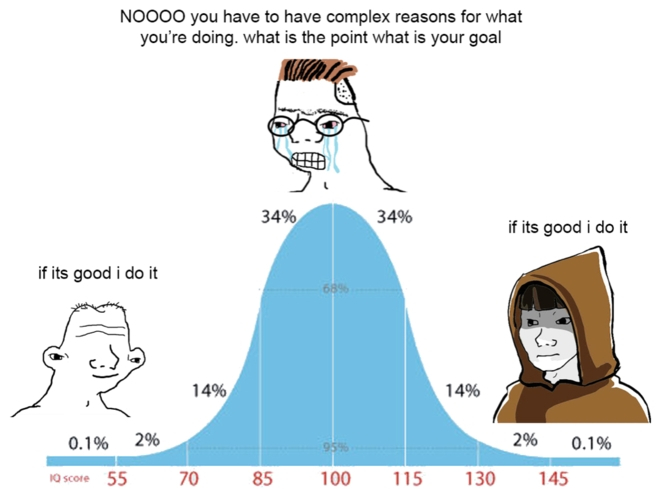
Women suffered much more than men from cooking, as shown best in their list of scientific achievements, or merely the amount of work performed by men at their job (and number of overachievers). By that I mean women’s relative dearth of achievements. IQ tests show women as more centered on the mean, lacking much of the genius and high-achieving spectrum responsible for the advancement of society, but lacking in the clinical idiot category as well, relative to the norm. Men strive for what they perceive as just or improvement: revolutionary groups, for ill or bad, have always been male-dominated. Women relish in the status quo and socially accepted opinions.
Women as a group lack in the ingenuity, curiosity and rationality departments, hence have trouble to innovate, instead defaulting on social thinking on the lines most susceptible to promote them or their female peer group in any context. How many can really put emotions aside when considering a sensitive issue, whatever it may be ? The cause of this transcultural lack of soul lies in the different relation women have with the reproductive instinctive program compared to men. The reason being simply, they need to breed and care for children.
Female animals have been wired to dedicate themselves for the continuation of the species on a biological level, while males’interest in their offspring, let alone others’, is seldom, on a case-by-case basis and never compulsive: when present, the “paternal instinct” is a secondary adaptation not directly related with the biological side of reproduction. Male animals’ foremost role is to pit their genetic qualities against one another (or against predators) to earn the right to diffuse their seed far and wide: we are the spearpoint of evolutionary innovation with all the failure rate that implies.
In everyone, feedback (from cereals—gluten—in particular) amplifies all our baser, grosser impulses, disrupting that harmony. But due to their tigher ties to reproduction, women are shoved to an even baser, material level from the moment their reproductive instincts kick into gear around puberty, cutting them for the biggest part of their extrasensory potential.
Their whole behavior from age 13, becomes centered on securing material resources from a male. This effect of undue sexual differentiation before puberty is light though existing: but it can still be fought and opposed by education, which arrives too late otherwise. This set of tendencies form the breeding instinctive program which is the core of lesser species whose entire lives revolve around reproduction:
Nesting: having a big, comfortable house (even when children are far, far ahead in the planning or unthinkable with current partners), cleaning the house, cooking (feeding the fledgeling !).
Gossiping
Keeping the men busy or downright manipulating them with sex to secure a caretaker for the kids and provider of resources, and detract them from other competing women.
The brain undergoes a metamorphosis which floods the mind with exacerbed reproductive impulses, compounded by fifteen years of pent-up energetic frustration then poured into budding reproductive impulses. That moment at the onset of puberty is the last moment to initiate a child and develop the metapsychical program, or else breeding (with or without contraception) becomes the dominant sensibility, and the child loses track of his destiny for good.
Virgin girls tend to keep longer an air of purity to them, as do lesbians, due to reproductive sex (coitus) further activating the instincts of reproduction and all that comes with it. The antipathy for any any novelty disrupting the established order expresses the animal fixation on the material stability and safety of the nest, disregarding the truth. If men typically confuse energy or divinity with the intellectual output of their hyperactive brain, women instead confuse it with their “feelings”. Politically they always gravitate toward a short-sighted social conservatism and conformism (reduced to “what they know and feel around them”) and a shalowness of character and lack of true empathy while craving for other women’ appreciation. This has been noted by nearly all intelligent people, such as Otto Weininger21, Carl Jung and Esther Vilar.
This has been explained recently by girls’ harder time in reaching their clitoris, which is anatomically their only source of pleasure, without being introduced by someone else, compared to boys for which their sexual needs are always closer to his mind, and his sex to his sight. This, coupled with the overall increase in libido in men relative to women that cooking induces (hence the constant need to fuck) makes it much more likely for the boy to touch himself. On the other hand girls can easily spend their whole childhood or even life, without a single orgasm, robbing them of any inner life, any strong feeling of any kind. However this can only be partially true, an aggravating factor, and actually more of a symptom than a cause: modern women, lesbians included, have access to orgasms but pleasure without energy does not make them equal to men, it only fuels in them an unlimited sense of entitlement and vanity. There might be no escape their inborn predisposition to the mediocrity of the breeding program, once it has settled.
As a consequence we rightly perceive female sexuality on a coital level as intrinsically dangerous and ravenous, feeding off virile energy and emasculating us. No better illustration exists than the world-wide primeval myth of the vagina dentata. It is a function of the Collective Unconscious we call mythogenesis to serve as a constant source of inspiration for artists and scientists, and make available in fictional content fundamental truths and warn us about grievous mistakes in our lives the same way Jungian dreams do, but on the scale of whole societies, or humanity as a whole. Whether they are biologically encoded or received from the Immaterium, each sex has its own set of unconscious inborn basic narratives or picturesque patterns, from which we generate either unconscious content or artistic and cultural productions of all kinds. They express our strongest fears to protect us from the risk of spiritual destruction that an unnatural sexuality carries.
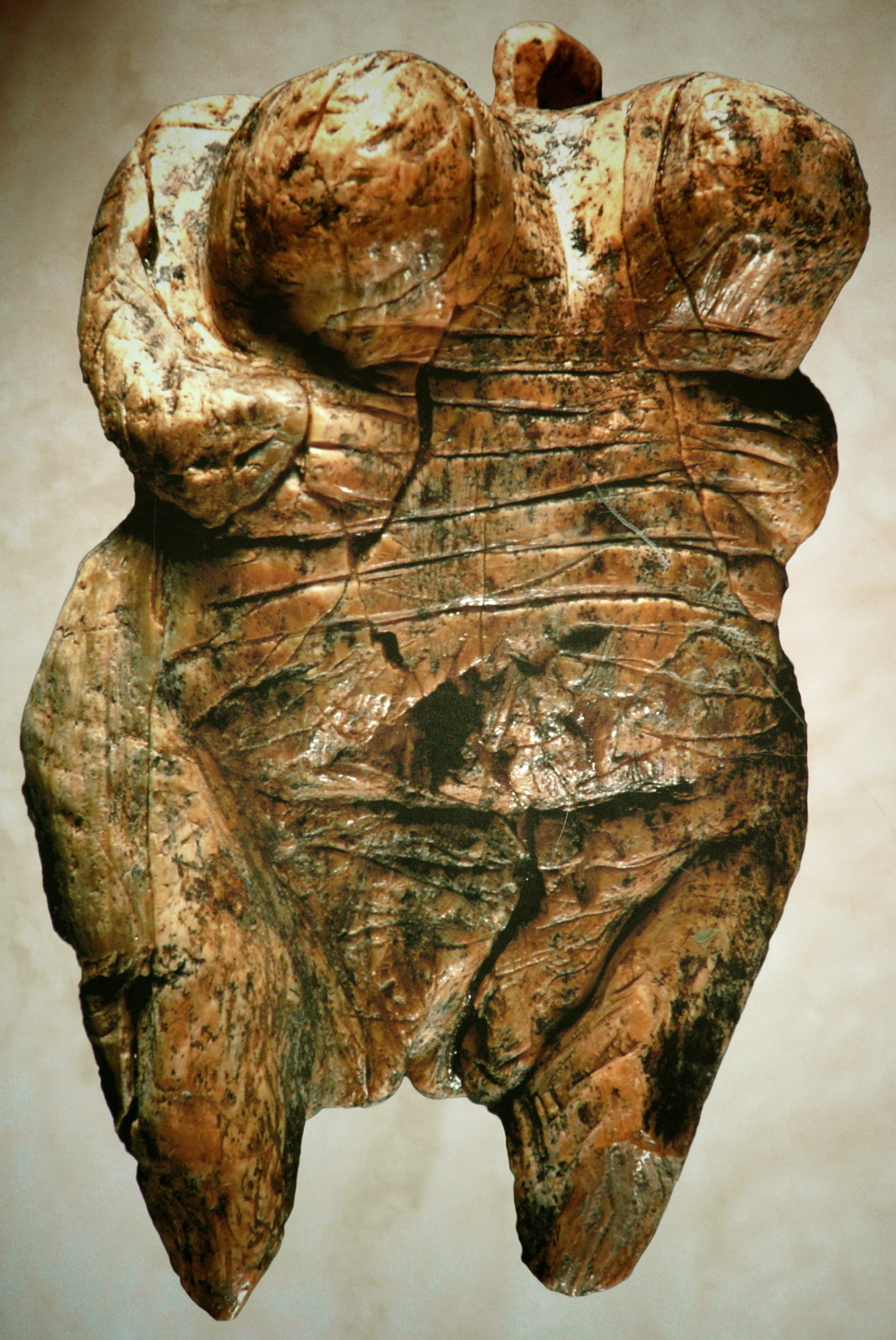
Venus of Hohle Fels (Aurignacian, 35,000-40,000 BP)
This inborn instinctive function called mythogenesis22 evolved to protect our most important assets (our spiritual, metapsychic integrity). It has been on throttle since the start of cooking, as evidenced by the strikingly profuse amount of the Paleolithic Venuses, figures found scattering all of Europe up to Asia Minor (Anatolia, current Turkey), which hyper-emphasizes characteristics of fertility, or as we say, the breeding program. For further use, let us note how Paleolithic Venuses appear at the exact moment we, for unrelated reasons, date the start of cooking.
Needless to say, such gross extremes hardly ever reflect real preferences, not even in the most debased corners of Africa. Even they noticed obesity to such levels is neither economically viable, nor a good trait to pass to children, or amenable to making a lot of them in the first place. Such imagery only inspire horror and disgust in 99% of people world-wide, how stuck-up and stupid can academics be to believe these were evidence of fertility worship ? So if they were not, they were the opposite. Symbolic scarecrows conjured by the popuplations of the time (cooking and naive but still very close to their original instincts) to repel by sympathetic magic the budding tendency of girls to degenerate both in body and mind with denatured food.
Why it stopped is unknown, maybe people had lost too much of their sensibility by then. Because this is the number one issue (save for cooking), women, vaginas and all the evils they unknowingly and for the most part, unvoluntarily unleashed on the world, are the epicenter of all myth-making activities everywhere in the world. All myths and religions try in their way to solve (or justify, usually both) the spiritually relevant issues of the sexual programs and their social effects.
Instead, the most likely explanation for those figurines, lies in the conjunction of an increased tendency in women to fatten a bit, which must have shocked to their core primitive people still mostly atuned to their instincts, and in men, for reproductional hints to start overtake metasexual, inspired criteria of beauty. It represented not a goddess, or the symbol of fertility cult—as if making more babies was ever a difficulty—but instead a conjuration of sort to exorcize what they must have seen as demons taking them over, akin to why wed used to set up scarecrows and gargoyles to scare off bad spirits, as primitive populations explicitely tell to ethnologists. Fattness and breeding fantasies have been scared for a long time.
From innocence to a semen demon
The content of actual fantasies most often take after mixed traits, not entirely pure nor impure, between good (the metasexual) and evil (the “bestial”). If caricatural machistic (or the simpering, beta-male kind for the matter) heterosexuality exemplify true degeneracy, one could consider on the other hand that sodomizing girls acts as a natural counter-balancing drive, the polar opposite of degraded heterosexuality, thus helping in freeing up the libido invested in the breeding instinctive program.
The ultimate reason, as always, is very much sexual: while the center of pleasure for girls is their clitoris, it has no function in breeding, so we observe with cooking and puberty (sometimes earlier) a transfer of libidinal focus from the clitoris, still natural with prepubescent girls, to their vagina. Even when they know very well nothing good comes out of it, even when they complain men only think of that, the unexplainable fascination overpowers them, and it almost unvariably hurt their dignity as women when their partners do not like vaginal penetration. Then, adding insult to injury, typical patriarchal prejudices against girls, while indeed justified for the reasons explained above, went too far and compounded women’ inferiority by relegating them exclusively to breeding roles, thus all but barring the few women endowed with inspiration (that is, with a virile personality to some degree) from achieving their potential.
None of that weak shit
Long live tomboy nationalism
We shall renounce both fake traditionalism and feminism, and engage a two-pronged attack on diet and culture in order to stop the root cause of cooking while promoting strong pederastic values for genders, putting men and women on equal footing and expecting from both the same sexual fulfilment from birth, hard work and achievement. We will etch into their very bones a lesson in self-dependency and strength of character they will remember for millenia.
Obviously breeding is a natural function too, a very important one and demands the highest level of spirituality purity, leading to the notion of immaculate conception present throughout the world: Isis was goddess of magic, virginity, sexuality and motherhood all at once and coupled with her brother to create the divine child. But 99% of the time breeding ought to stay as remote of a concern in sexual relationships for everyone. The constant flow of energy should feed the occasional births, as announciated in visions, prophetic dreams and breeding instincts stay under control of the metasexual/metapsychic program. Since we wouldn’t breed more than a few times per life to maintain population levels.
The reason effeminate men exist, and demonstrably have existed probably for the longest time but have only now not only taken the spotlight, but become the dominant type among homosexuals, is the very worsening chemical disturbances in our environment, from diet for the most part, although the role of industrial pollutants keeps on growing, with the same degenerative effects we see in humans, starting to show on “wild” animals.
Factors in the genesis of the faggot or effeminate personality arise from either exogenous influences (society and upbringing) aka secondary masochism, and endogenous influences aka primary masochism" under the pressure of denatured molecules.
Observing animals living together and fed without processed food goes a long way to convince us, that for the most part abnormal personality traits (fetishes, antisocial violence, lack of empathy, apathy) is always due to a defectious upbringing, wrong or absent role models, wrong ideology and processed food, usually a combination of the three, with the latter effect being the most important, in the sense that it cannot be offset later in life no matte what, because it affects the brain on a biological level.
Quickly, the only conceptual framework remaining in a culture to think about love, is reproduction. No matter the racial and cultural background, invariably populations over time develop similar concepts of sexual normalcy where “natural order” equals one male and one female about the same age, to make kids raise them and look after them until they grow up, then rince and repeat. This may not preclude homosexuality from being valued and understood to a degree, as many cultures proved, but it is a demonstrable inevitably that said comprehension will erode over time, sometimes in a matter of decades along with increasing food sophistication.
Degenerate base impulses became stronger and stronger, ever more mothering the suble sensitivity for anything belonging to the metasexual program. The equation “sex = reproduction” invariably becomes the perceived natural norm as cultural degradation takes place, simply because it mirrors the degenerence of our inner nature, and we cannot fathom anything else. Some individuals are allowed to differ if they feel like it, but the meaning of their deviant behavior is lost to the majority, and for the most to them as well.
Thus throughout history it is homosexuality’s fate, often exemplified or resumed in the practice of sodomy, becomes either/or misunderstand or hated by the majority of people who can not relate to it any longer. Of all deviancies, of all impulses of a metasexual origin, it is the first to strike as contrary to the heteronormative natural law. The homosexual drive becomes alien to a people falling into the breeding program, because it does not belong to it.
And because of that very misunderstanding, it becomes repressed, but because it can not disappear it produces instead a constant state of shame while expression becomes compulsional, violent and charged with self-loathing: disconnected from the magical source it originates from. This results from the inner contradiction between our attraction, and the compounding of what Freud called first and secondary “masochism”, a desire to be punished for perceived sins against morality.
The true homosexual
As a way to cope with this double pressure of the Over-Ego (internalized opinions of society) and the Over-Id (what remains of our original instinctive morality), some people double down on the heterosexual model by lying to themselves, and masquerading as the most rabid homophobes, while others instead ape women (or men, respectively) in mannerisms and appearance, giving us the familiar effeminate faggot or butch stereotypes, respectively. Ultimately, we get transsexualism. We simply try to appease our conscience by conforming to the dominant model.
Starting in the Weimar Republic, the homosexual community has always been divided between the heralds of the virile, nationalistic sensibility, the true inheritors of Greek pederasty and almost always embracing age gaps and children, and on the other hand the sensibility which would dominate from the end of the war onward, the conformist, antifascist, degenerate homosexuals. After the satanist scare fell off in the US in the 90s, pedophilia became the new demon to exorcize and all homosexual organization started hunting “boy-lovers” in their rank. They chose society over integrity (and very consciously too.
Initially the pedophile question called for much attention, from starting from the 70s, homosexuals looking for a quick social integration in the society dismissing, extremely embarrassing in their eyes. At the same time, as the issue pressing and diabolization more intense, relationship between adults and children or rather that of children’s right to consent became the core of sexual liberation in general and homosexual liberation in particular.
Today evil fully won. To integrate, in their bulk homosexuals have chosen to adopt all traits of reproductive sexuality: consume, marry, long-term exclusive monogamy, even adopt children.
Ancient Greeks were famous for their love of prepubescent young boys representing the epitome of physical beauty. This however reflected a certain part of society, the higher classes, which inherited those values from aristocratic times. Pederasty was an ideal, with various interpretations. But if opinions on the passive role for adults could differ pederasty itself was universally tolerated if not praised and no one thought of forbidding anything by law, regards to age or gender.
Currently a great many people opposed to the LGBT movement throw the baby out with the bathwater and lie, picturing Greeks as not just homophobic, an attitude universally unthinkable back then, but unilaterally so. Distinct from the now prevalent or publicly acclaimed effeminate homosexuals transsexuals and other psychiatric abominations, have always stood the relationships practiced by the highest geniuses and warriors throughout the millenia. This approach and perception of love as a whole begets high cultures and eternal values wherever it blooms, in contrast to the self-centered hedonism of degenerate drug addicts and leftists making making the bulk of today’s homosexuals and wrongly called “pedophiles”.
Fake reactionary propaganda
Prostitution relates to porneia, the kind of love solely focused on using and abusing the body of others with no spiritual motives whatsoever, was common too, for both sex. But free boys willingly prostituting oneself was repellent to most. Among the Athenians, as Socrates claims in Xenophon’s Symposium, “Nothing [of what concerns the boy] is kept hidden from the father, by an ideal lover”. In order to protect their sons from inappropriate attempts at seduction, fathers appointed slaves called pedagogues to watch over their sons. However, according to Aeschines, Athenian fathers would pray that their sons would be handsome and attractive, with the full knowledge that they would then attract the attention of men and “be the objects of fights because of erotic passions”.
And bisexuality was a given, so the arguments that only aristocrats would indulge in boys’ love makes little sense since, as Xenophon said, “streets are full with people willing to oblige”. It appeared useful to debunk a number of myths, using the aforementoned false quotes:
Below I comment an excerpt from his Symposium, in which he clearly refers to sexualilty explicitly, also outlining the same dichotomy of a heavenly, mystical pederasty versus reproductive heterosexuality, as well as the true purpose of love, which is immortality or “growing the wings of the soul”: all notions still at the core of metapsychoanalysis 2500 years later.
I will make my meaning dearer, she replied. I mean to say that all men are bringing to the birth in their bodies and in their souls.
What then?
The love of generation and of birth in beauty.
Yes, indeed, she replied. But why of generation? Because to the mortal creature, generation is a sort of eternity and immortality, she replied; and if, as has been already admitted, love is of the everlasting possession of the good, all men will necessarily desire immortality together with good: Wherefore love is of immortality.
Plato
This was a fake form of immortality, still prone to eternal change and decay, barely an approximation of the true one, the immortality of the soul:
They [those in love of the beauty of the soul] are ready to run all risks greater far than they would have for their children, and to spend money and undergo any sort of toil, and even to die, for the sake of leaving behind them a name which shall be eternal.
I am persuaded that all men do all things, and the better they are the more they do them, in hope of the glorious fame of immortal virtue; for they desire the immortal.
idem
The two kinds of love do not compare in their effectiveness, because the children of the body die while the children of the soul go on forever, alive in the minds of everyone thousands of years later far past one’s bloodline’s boundaries or life expectancy. If not lasting forever beyond time, in the archetypal dimension.
And he who in youth has the seed of these implanted in him and is himself inspired, when he comes to maturity desires to beget and generate. He wanders about seeking beauty that he may beget offspring-for in deformity he will beget nothing-and naturally embraces the beautiful rather than the deformed body; above all when he finds fair and noble and well-nurtured soul, he embraces the two in one person, and to such an one he is full of speech about virtue and the nature and pursuits of a good man; and he tries to educate him; and at the touch of the beautiful which is ever present to his memory, even when absent, he brings forth that which he had conceived long before, and in company with him tends that which he brings forth; and they are married by a far nearer tie and have a closer friendship than those who beget mortal children, for the children who are their common offspring are fairer and more immortal.
idem
The following resumes Plato’s notion of sexual wisdom: from one beautiful body to many, from one beautiful soul to many, then to divine essence beauty itself. So not only are physical relationships, they should be free and plenty. Active sexuality (with men) is explicitely recommended, as a means to connect to the higher essence of beauty.
For he who would proceed aright in this matter should begin in youth to visit beautiful forms; and first, if he be guided by his instructor aright, to love one such form only—out of that he should create fair thoughts; and soon he will himself perceive that the beauty of one form is akin to the beauty of another; and then if beauty of form in general is his pursuit, how foolish would he be not to recognize that the beauty in every form is the same!
And when he perceives this he will abate his violent love of the one, which he will despise and deem a small thing, and will become a lover of all beautiful forms; in the next stage he will consider that the beauty of the mind is more honorable than the beauty of the outward form.
idem
How anyone, even pederasts, can conclude Socrates thought sex as “lowly” or unfit from this same dialog, leaves us aghast. Other books such as Phaedrus promotes a more appeased approach not consumed by passion, but it is obvious touchings are not the issue. They should be an ornament to something going deeper.
Now onto the incriminating statement from Republic:
It’s contrary to nature
Republic
There is no 636c in Republic, which ends at 621d. That quote is from Laws, to which we will come afterwards.
Can you tell of a greater or keener pleasure than the one connected with sex? Is the naturally right kind of love to love in a moderate and musical way what’s orderly and fine? Nothing that’s mad or akin to licentiousness must approach the right kind of love? Then this pleasure mustn’t approach love, and lover and boy who love and are loved in the right way mustn’t be partner to it?
Republic, 404
It should be obvious that this is a pastiche of a sophists’ argument, and not intended to be taken at face value, especially considering how liberal Plato’s republic actually is regards to moral or sexual affairs (about incest for instance).
Extending arguments out of any sane limit leads to logical falacies, here the end of all sexual pleasure whatsoever. Anything moving spirits even slightly above the normal should be forbidden, until we all become perfect philosopher robots. This was written at most in 375 BCE according to criticisms while Symposium was written between 385 to 370 at the earliest. And this is nothing compared to Laws, the most loathed of his works.
One work talks of divine folly and uranian desire growing the wings of the soul, developing extrasensory perception, political and artistic qualities, while Laws literally bans all desire and pleasure. Every proposition betrays the wish to regiment every single aspect of life, stifling and drying up any possible source of creativity.
Why would Plato teach something already completely at odds with its former works, both in tone and content ? What was he even teaching, what have people like Aristotle come to believe as the true doctrine of their master, accessing divinity through mystical pederastic sex ?
We can explain this by his life so far.
Athens had experienced the rule of the 30, an oligarchic clique put in charge of Athens by Sparta after its victory. But what exactly happened with these so-called “tyrants” (thirty men mostly of high birth, high education and high social standing) is very contentious…. That they would execute 1500 people in 8 month for money and power is nothing but democratic black propaganda.
Then he had a bad experience with Denys 1er de Syracuse, tyrant de Sicile, in 387 just before starting the academy, in 387, a young man he endeared to love and educate but which dismissed him in the most ignoble manner, leading (as goes the tradition) to his capture as a slave.
What Plato had gone through, was the failure of the aristocratic dream for his beloved city and a major love burn.
Then he wrote the Republic and Symposium, in the same span of time, and Laws as his last title, a work of pure insanity: People are described as cattle to be ordered and manipulated through made-up religious fear, threatened and beaten up if they do not dedicate themselves to breeding. Nothing but empty celebrations to appease the masses, no science, wonder or discovery, innovation or meditation. Only war, theater, eating, sleeping and breeding. Even romance is prohibited.
When the legislator wants to tame one of the desires that dominate mankind so cruelly, it’s easy for him to see his method of attack. He must try to make everyone—slave and free, women and children, and the entire state without any exception—believe that this common opinion has the backing of religion.
He [the non-breeder] must be deprived of the privilege of attending weddings and parties celebrating the birth of children. If he persists in attending, anyone who wishes should chastise him by beating him, and not be punished for it.
Plato
How could anyone ever take this seriously ? Naturally Laws go on to claim explicitely that homosexuals make no contribution to virtue through emulation… no more than any form of love, a notion simply incomprehensible in the whole Mediterranean.
Moreover, it is overpopulation which Greek cities always suffered, on which Aristotle and Plato himself blamed the Peloponnesian War as Athens exceeded 100 persons per square mile of lan.
Already the Republic ironized constantly suggesting outlandish solutions to imaginary issues, although its tone was still light. Laws simply took it to the last logical conclusions, as a final “fuck you!” of a man who had lost faith in humanity after Socrates’ execution and his tragic involvement with Dion and Denys the Young, which he less than subtly roasts several times in Laws.
Regardless, to claim that Plato denigrated homosexuality in Laws is beside the point: he denigrates all sexual pleasure whatsoever and anything not strictly reproductive even within a heterosexual context, an attitude so hardcore as to make Islamists blush. Not a drop of sperm wasted outside a fertile womb, oy vey !
εἰ δέ τις παιδὸς σώματος ὀρεγόμενος φανείη, αἴσχιστον τοῦτο θεὶς ἐποίησεν ἐν Λακεδαίμονι μηδὲν ἧττον ἐραστὰς παιδικῶν ἀπέχεσθαι ἢ γονεῖς παίδων καὶ ἀδελφοὶ ἀδελφῶν εἰς ἀφροδίσια ἀπέχονται.
If it was clear that [this attraction] resided in the boy’s body, shameful in Sparta and [he] caused inferior lovers to …
Constitution of the Lacedaimonians
Perhaps the most “negative” testimony toward homosexuality would be Xenophon’s Constitution of the Lacedaimonians, who has had a first hand knowledge of Sparta where he sent his kids to be educated. This quote supposedly proves his disdain (and Sparta’s) for homosexuality, but the original Greek is subtler than that and nowhere in all his works does Xenophon condemn it. Texts explicitely emphases not abstinence but temperance, not refusal but discrimination in one’s pleasure so as to better serve the common good of oneself and the city.
According to all reports, up to the rise of Alexander the Great, Sparta was unanimously recognized as an ideal, collectivist eugenist and sex-positive White ethnostate, ripe with eugenicist and a near-complete abiding by natural instincts, all leading to a superior intellect and boundless martial might that left the whole Mediterranean world in awe. And such a high place of pederasty that women would often take under their wings younger girls in the same fashion as was customary for boys and older men in the rest of Greece.
State-mandated pederasty
The ban on sex, which was no ban at all, textually only applied only to lovers “whose attraction resides in the boy’s body”, a sentence that should leave no ambiguity.
The most important word was omitted in the two most widespread translations: ἧττον, masculine nominative singular form and comparative of the comparative of ἥσσων, meaning “lesser” or “inferior”, with ἧττον ἐραστὰς meaning “inferior lovers”. Lycurge told inferior lovers to back off from kids, not all lovers. So this kind of law or customs reflects a superior inspiration. A translator even came up with “attraction to a boy’s beauty is abomination”. Such remorseless lies warrant nothing less than lengthy rape by highly muscular men.
Xenophon’s depiction of Socrates is often claimed to differ a lot from Plato’s but nothing is further from the truth. His own Symposium (a depiction of the same events, alleguedly) lists the same the two Aphrodites, the “heavenly” and the “vulgar” with the same characteristics of promoting respectively noble values and excellency through emulation and for the other, “looseness”, unreliability and feebleness of character.
In another miscontrued quote (Memorabilia, book I, section 2 ¶30-31) Socrates supposedly berates a friend on the basis of his attraction to a boy:
Well, when he found that Critias loved Euthydemus and wanted to lead him astray, he tried to restrain him by saying that it was mean and unbecoming in a gentleman to sue like a beggar to the object of his affection, whose good opinion he coveted, stooping to ask a favor that it was wrong to grant.
Xenophon
The point is explicitely the absence of self-control, the man’s impulsivity effectively giving him the aspect of a lowly animal. Not being listened to, he goes on to liken him to a pig: “Critias seems to have the feelings of a pig: he can no more keep away from Euthydemus than pigs can help rubbing themselves against stones”.
Here and everywhere else the term έρως always convey the meaning of erotic feelings, inseparable of the sexual component. Similarly, the word often translated by chastity, associated to the heavenly Eros, only came to mean abstinence in the late 19th century, but conveyed before the notion of “moderation” or an “appropriate” conduct. And the term of “carnal love” attributed to the vulgar eros does not mean “physical”, but “lying mainly in the physical”, explaining how Athenian fathers could both protect their sons and prompt them to attract men… proper men.
As for the fake quote, I defer to this commentary. Plutarch states plainly that the boy in question was a prostitute, and Alexander found prostitution morally abject, like sexual slavery. And how is the following not gay ?
The story goes that he was drunk while watching some dancing competitions, and that Bagoas, whose lover he was, won a dancing-prize, came through the theater in his finery and seated himself next to the king. Seeing this, they say, the Macedonians clapped in applause and loudly called for Alexander to kiss him, until eventually the king took him in his arms and gave him a kiss.
This traduction does not exist.
True, Aristophanes was a notorious opponent of pederasty, who built his fame by making his public of tens of thousands of well-bred Athenian males of all ages laugh, by accusing them of what a lot of adult men were complicit in the passive role. Homosexuality by default implied a sodomy, which requires a passive partner, but both partners would be free citizens.
So supposing public morale usually looked down upon passivity, this couldn’t possibly a monolithic judgment, as all adult men doing the sodomizing by default had been “tutored” by an adult man while younger, and thus, penetrated. While the idea of a natural order exists, to label people as wicked from deviancy alone regardless of actual harm to society or individuals, was simply a level of normativity non-existent before Judeo-christianity.
In Greek and even more Roman society the distinction between effeminacy and passivity has always been vague, I would argue properly schizophrenic. I would argue the more cooking developed and the less grip public institutions had on the collective, the more the ambiguity would take hold. This is why a very strong collectivistic culture is necessary with our lifestyle, and why Sparta kept its edge longer.
Judging from their medieval latin adaptation, these fables written by a former Greek slave in the late to mid-6th century BCE were a collection of subversive and vulgar tales full of sex with whoever and whatever the ugly Aesop had at its disposal.
Representing somewhat of a counter-culture, this might explain why the mythical author (which most likely never existed, like Homer himself) has been imagined as a slave by a few Greek historians.
Regardless of some written disparaging discourses, it would not have made any sense for a young aspiring citizen in a very public relationship, to publically hide his being penetrated (or for others to seriously mock him for it), since he was expected to. Slight taunts do prove a state of moral ambiguity, but justified though:
People who did practice sodomy for pleasure only, as one would fuck a prostitute, would resent the taunt, feel shame and reconsider their attitude. While those sure of their probity would not feel concerned.
This double-discours attitude survived in the Middle Age despite nominally much sterner admonitions and theological implications, yet with as few actual condemnations.
[137] to hire for money and to indulge in licentiousness is the act of a man who is wanton and ill-bred.
Aeschines
This book explicitely scorns prositution. Aeschines describes himself as a lover, in this context a pederast, and that it is honorable, explaining that real love can not explained between free men and slaves for that love can not be free, with the only restriction as the former should exert “self-restraint” when the latter hasn’t reached 11 or so. Yet there was no law against proper pedophilia, if parents agreed. In fact, people considered stalking by an adult of good repute as a protection against lesser suitors.
The pathological kind may result either from people’s nature or from habituation. I mean things like … pulling your hair out … biting your nails … eating charcoal, or clay [likely a reference to pregnancy cravings, or pica more generally. Both of these particular cravings are known in pregnant women]… and, we might add, female sexuality in males. Because in some people those things arise from their nature, in others from habituation, i.e. when they’re trained into them from childhood. So in all cases where the cause is their nature, nobody would speak of them ‘not being able to control’ [those urges] (just as you wouldn’t say women ‘lack self-control’ for having the non-penetrative role sexually), and the same goes for any pathological states that result from habituation.
Aristotle
He thus equates being penetrated anally (which was but a part of male-male sexuality, even though a good one) with either a deviation from nature or something bred by habit, which is to say a statistical deviation from the norm, put in the same category as biting your nail or eating charcoal (which is actually healthy), and devoid of of moral taint nor bothersome.
For Aristotle passivity could coincide with effeminacy but did not cause it23, or he would have been call faggots a whole lot of old(er) well-bred men. He never insinuated passive penetration was “morally wrong” or entailed “female sexuality” entailed lacking courage or virility. And he elsewhere describes pederasty as socially useful and ethically valuable.
While not denying a certain reality, the famous Roman hate for sexual passivity is both misunderstood and exaggerated. Surely enough, Romans were too hasty in associating effeminacy with passivity, but it wasn’t unconditional either.
Individuals of high stature whose virility laid beyond any doubt, could afford being both feminine and masculine. Truth be told, effeminate gays do indeed make for the bulk of homosexuals today, so the association isn’t (and wasn’t) entirely fortuitous or mean. But neither homosexuality nor passive sodomy was ever forbidden, and barely frowned upon…until Christianity took over.
Overall we can assert confusion between two programs always existed, and all social measures regards to mores express an unconscious or conscious will to protect transcendance. Our interpretation of all of ethnology and history should be revisited with the two instinctive programs of love in mind. We need to rethink our whole literature.
Greeks and Romans understood rather keenly a divide between porneia and eros, or we would say in more modern terms, concupiscence/lust compared to metasexuality or spiritual love. Temperance is not not continence, just like being willing to test and raise one’s pain threshold is not torture, as long we don’t push it too far. Self-control was the most praise-worthy value, and only enhanced and honored one’s love for the beautiful:
Is it not worth mentioning his self-control in erotic matters if for no other reason than one’s amazement at it? One would say that his holding off from those he did not desire was merely the act of an ordinary human. But he loved Megabates, the son of Spithridates, just as the most intense character would love the most beautiful boy.
Plutarch
In the end, the apparition of this complex and mostly hypocritical attitude toward anal passivity, in unrelated cultures (in Greece, Tibet, China, etc), is indicative of something deeper. Firstly, we see an unmistakable tendency to scapegoat people who refuse to play by society’s game, refuse to marry and loose themselves in the futility of reproductive sexuality. They too, like incestuous lovers, provide a stinging reminder that our society is based on a lie. The second reason, is that homosexuality degenerated like all forms of sexuality, though much less so than heterosexuality, under the weight of ever more complex cooking recipes.
As a disclaimer, I want to set the record straight as to a number of documented capacities, often related to yogic traditions, which however extraordinary they may be, requires in theory no more than intensive and motivated training, and do not pertain to the category of miracles.
Abilities documented in yogic and contemplative traditions — such as the Tibetan gTummo (inner heat) practice, or Lung-gom-pa (sustained running for 48 hours without rest) — demonstrate that deliberate training can provide measurable access to ordinarily unconscious physiological functions. These represent the trained, effortful end of a spectrum; the savant and the mystic appear to occupy different points on the same continuum.
The question of why such capacities require such intensive conditioning — rather than being available by default — is worth taking seriously. If these are natural functions of the organism, the need to spend decades recovering access to them suggests something has altered our baseline state. It makes sense that the extrasensory may once have been the ordinary mode through which such functions, among a plethora of other skills like learning piano or math, were once activated. Now let us dwelve into the parapsychology proper and incontrovertible evidence.
The PSI effect is statistically small in most settings, but its reproducibility across enormous samples — particularly for precognition — has been established with statistical power comparable to that required in conventional social psychology, and substantially higher than much biomedical research, which faces an endemic replication crisis.
Formal reviews of psi phenomena published in peer-reviewed journals have returned consistently positive findings. The military’s Project Stargate yielded odds against chance of 1.6 million to 1; Princeton’s research produced 33 million to 1. Meta-analysis — the recognized method for synthesizing results across many similar experiments — demonstrates that small, systematic effects pointing in the same direction accumulate into very strong aggregate evidence. Statistics alone, without even considering other undeniable historical and acecdotal evidences, already establish the reality of the psi beyond any doubt.
Even primitive animals appear capable of anticipating events that will produce strong effects — preparing either to flee or to endure. Carefully controlled experiments isolate this capacity by contrasting expected randomness with actual outcomes. René Peoc’h demonstrated this robustly: newly hatched chicks, distressed in a dark room, attracted to themselves a light-bearing robot whose movements were governed purely by random number generation — a compelling demonstration of (micro)psychokinetic influence in an extremely constrained setting.
People born blind have reported visionary experiences of remarkable precision and richness — perceiving unknown colors, seeing simultaneously in all directions, above and below — qualities they should, by any conventional account, be incapable of conceptualizing.
The extrasensory appears to require a calm, unstimulated nervous system. This may partly explain why controlled laboratory conditions still yield only modest individual effects: even under optimal conditions, consistent access to psi capacities seems to depend on broader physiological factors.
From a wide review of the parapsychological literature, the following phenomena appear, on balance of evidence, to be real:
Telepathy / empathy
The direct perception of others’ mental states — emotions and thoughts — willingly or not, and more rarely the impression of one’s own thoughts upon others
Psychokinesis
the influence of mind on physical systems.
Bilocation
the ability to be or appear in two (or more) locations at once.
Intuitive understanding
acquisition of knowledge without ordinary study or sensory input.
Luminous emanation
A bright light surrounding the head, face, or whole body of certain people, also known as aura.
Supranormal command of the body
It includes the suppression of pain, limitation of blood loss, and accelerated healing.24 Things that really can not be learned or trained.
Perhaps the most extraordinary claimed human ability concerns levitation. Yet its historical reality lies beyond any reasonable doubt:
There are between two hundred and three hundred historical cases in the lives of the saints, including that of St. Joseph of Copertino (1603–1663). He was observed to levitate by thousands of witnesses, usually in daylight, over a period of thirty-five years. The testimonies are found in the private diaries of witnesses and in depositions made under oath, including 150 observations by nobles, kings, and princesses.
There are also purely secular cases of levitation, the most well-known being that of the Scottish medium Daniel Dunglas Home (1833–1886). Like St. Joseph, Home was observed levitating in broad daylight by dozens of prominent witnesses. No fraud was ever discovered.
The Man Who Could Fly: St. Joseph of Copertino and the Mystery of Levitation
The case of Kim Peek is among the most thoroughly documented in the literature on exceptional cognition. Born with severe structural brain damage — including near-complete agenesis of the corpus callosum — he should not have survived infancy with any significant function. Instead, he developed abilities that challenge every standard model of cognition:
Simultaneous reading of facing pages, one eye per page, in approximately fifteen seconds, with near-total retention26
Reading pages held sideways, upside down, or as mirror reflections, with equal facility
Apparent comprehension of muted television dialogue
Savant abilities are sometimes explained as one brain region compensating for another’s failure. Peek’s case sits uneasily with this model. The majority of severely autistic individuals show significant cognitive impairment with no exceptional abilities — making savant capacity the exception rather than an expected byproduct of the condition. Moreover, in some cases young savants with autism lose their special abilities when they acquire language, suggesting a trade-off of some kind; but Peek showed no such loss. He continued acquiring new skills and capacities throughout his life with no apparent compensatory decline — while his mere survival past infancy, given a condition that typically produces a vegetative outcome, was already without precedent.
One interpretation is that the brain, under certain conditions, can interface with an information space not bounded by ordinary neural architecture — offloading computation and storage in a way that bypasses the usual limits of sensory processing and working memory. The resulting capacities parallel what Out-of-Body and near-death experiences describe as access to a different order of perception: instantaneous, panoramic, and not dependent on the senses.
This would account for the instantaneous character of savant recall and calculation, as well as the consistent reports from NDEs of accessing knowledge that could not have been acquired through the senses. On this model, what savants and mystics access by exception may be what we were once capable of by default.
The phenomena gathered in this section differ in kind from those above. Rather than abilities latent within the human organism, they point outward — toward a world that is far stranger, and far more densely inhabited, than our current impoverished perception allows us to recognize. That impoverishment is not permanent or inevitable: it reflects the narrowing of awareness that follows from cooked food, the suppression of instinct, and the absence of metasexual development. What remains, for most people most of the time, is a flat and depopulated version of a reality that is in fact teeming with intent, consciousness and life.
Across centuries and cultures, accounts describe encounters with intangible presences — entities perceived as distinct from the experiencer, sometimes visually present but physically intangible, located in the air, underground, in bodies of water, in forests, and in the liminal spaces between the ordinary world and whatever lies adjacent to it. In the air, in the ground, in the trees and rivers, deep in mines and underground lakes — the testimony is consistent enough across traditions to constitute a phenomenon, whatever its ultimate nature.
A specific and recurrent subset of these accounts concerns encounters of an intimate nature with non-physical entities. In medieval Europe, such experiences were typically interpreted through a diabolical framework and associated with witchcraft.27 The experiential reports themselves, stripped of their theological framing, describe something more specific: an encounter that feels — to the experiencer — more complete and more satisfying than ordinary physical intimacy, precisely because it engages dimensions of the self that ordinary contact does not reach.
Such accounts resonate with what the original text describes as our deepest aspirations — those that literature and increasingly immersive art forms express at the edges of ordinary self-censorship. The desire for contact that engages the whole self, not merely the body, may be less a fantasy than a memory: of a mode of relation that was once available and is not entirely lost.
A contemporary account:
I realized that the “person” in bed with me — in front of me, I should stress — was a composite of various girls I had once known […] but with other elements not drawn from my memories in any sense. It was its own creature but seemed, as it were, to be using part of my own experience in order to present itself to me.
I can only say that the experience is totally satisfying. From some points of view the sex is actually more satisfying than that with a real woman, because in the paranormal encounter archetypal elements are both involved and invoked, a rare event in normal everyday relationships.
For forty years Benedict of Berne had kept up amatory commerce with a succubus called Hermeline.
Louis Proud
Finally, th most powerful and awe-inspiring phenomena by far, is Spontaneous Human Combustion (SHC). Each year a number of individuals spontaneously combust without identifiable fuel source, typically alone, most often indoors during sleep — though outdoor cases and surviving witnesses exist. It belongs to this list, as it also happens to humans and connects to forces beyond our comprehension or control. It is the most violent known point of contact between ordinary biology and whatever lies on the other side.
The physical outcome is consistently anomalous:
Complete reduction to ash, including bone — something professional crematoriums operating at over 2000°F for eight hours routinely fail to achieve28
Estimated energy equivalent to 110 MJ (roughly 30 kg of TNT), released in as little as fifteen to thirty minutes
Highly selective combustion: surrounding objects, and sometimes clothing, are untouched despite the extreme heat
In the great majority of cases, victims appear not to have cried out or been aware of what was occurring at all
Among the small number of survivors, lasting remission of depression and a marked reorientation of outlook have been reported — suggesting that the event, whatever its mechanism, either proves fatal or produces a profound and lasting shift in the person it touches. This pattern aligns SHC with other extreme threshold experiences — NDEs, certain mystical crises — in which contact with higher forces either destroys or fundamentally transforms for the better.
SHC, like the entity encounters above, points toward a reality in which human beings are not the largest or most powerful agents present and in which the boundary between the mind and its wider environment becomes permeable.
Because we do not find the most important, energy, we always look elsewhere and fantasize about exotism, whether it be women welcoming filthy Muslim invaders, Middle-Eastern women eagerly going for Christian crusaders hundreds years ago, men sailing for the West Indies or now lining up to buy Chinese or Filipina brides. We must solve the problem of love to end the threat of immigration and racial contamination once and for all. ↩︎
σύμβολος as an adjective etymologically relate to coming together, fated meetings, the joining of things meant to fit together. As a noun it also meant augury, omen. On the other hand διάβολος, which gave us the devil or “diabolical” literally meant that which disunites and inspires hatred or envy. ↩︎
[¶43] But the full extent of these projections from the unconscious became known through analysis of those obscure and inexplicable feelings and emotions which give some intangible, magical quality to certain places, certain moods of nature, certain works of art, and also to certain ideas and certain people. This magic likewise comes from projection, but a projection of the collective unconscious. If it is inanimate objects that have the “magical” quality, often their mere statistical incidence is sufficient to prove that their significance is due to the projection of a mythological content from the collective unconscious.
[¶53] Archetypes are systems of readiness for action, and at the same time images and emotions. They are inherited with the brain-structure—indeed, they are its psychic aspect. They represent, on the one hand, a very strong instinctive conservatism, while on the other hand they are the most effective means conceivable of instinctive adaptation.
Theorizing occurred very spontaneously, with observations in a hitherto unknown dietary context that could be called “preculinary referential”. The radical change in eating habits and elimination of all the stimulants present in common foods: gluten (cereals), exorphins (milk), caffeine, theobromine (chocolate), alcohol, AGE etc., made possible wholly unprecedented observations under cooking’s rule. Those taking part in this unusual experience saw their sexual excitability change dramatically. It was thus possible to bring out what can be called the natural laws of human sexuality and to highlight unknown—or generally hidden—relationships between amorous behavior and the development of extrasensory faculties.
Never, however, have we seen anything that could be regarded as homosexuality in chimpanzees… Admittedly, a male may mount another in times of stress or excitement, clasping the other around the waist, and he may even make thrusting movements of the pelvis, but there is no intromission. It is true, also, that a male may try to calm himself or another male by reaching out to touch or pat the other’s genitals; while we still have much to learn about this type of behavior, it certainly does not imply homosexuality. He only does this in moments of stress, and he will touch or pat a female on her genitals in exactly the same context.
Both sexes are very inclined to love, I was very surprised to see this passion develop early, to the point that boys, even seven or eight years old, have sex with girls of their own age (Tessier, 1776).
Aforementioned paper (translated)
September 21, 1601: Madame the Duchess of Bar, sister of the King, who considered the parts so well formed of this beautiful body, having cast her sight on those which made him the Dauphin, turning towards Madame de Panjas, his lady-in-waiting, told him that he was well endowed. These words were received with derision, which carried them to the ears of the King, who was close to the Queen.
July 24, 1602: Louis takes pleasure and laughs out loud when the stireuse shakes his cock with her fingertip.
September 23: Very cheerful, excited; he makes everyone kiss his guillery.
September 30: Louis XII then is just 2 years old ] At a quarter past twelve the Sieur de Bonières and his young daughter; he laughed out loud at her, rolls up, shows her his guillery, but especially to his daughter, because then holding her and laughing her little laugh he shakes his whole body. It is said that he meant finesse [that it was a salacious allusion]. At twelve-thirty the Baron de Prunay; there was in his company a little damsel; he rolled up his coat, showed him his cock with such ardor that he was quite beside himself. He lay down on his back to show it to her.
The industrial Revolution and the century leading to it—in no small measure due to the increasing place stimulants such as coffee chocolate and sugar too from the colonies in all social classes from the head down—marked a milestone in the degeneracy of our attitude toward sex, and a still ongoing repression that few periods in record history if any ever demonstrated, with commonly practiced surgical operations and lobotomies conducted for 150 years in the heart of Europe to combat masturbation. ↩︎
It seems that Aristotle mentioned the idea that Theseus and Helen invented anal intercourse, and since Helen was a Spartan heroine the original meaning of “lakonize” was to have anal intercourse irrespective of the sex of the person penetrated.
Kenneth Dover
Kleinias lakonised with the buttocks. To use loved-boys they call to lakonise, for that is how Theseus used Helen, according to Aristotle.
Photios
In Sparta, according to Hagnon of the Academy, it is customary to have sex with girls before they marry in the same way one does with boys.
Athenaios
Lakonizein
to use loved-boys in the Lakonian way penetrate; practice pederasty; [Women] offer themselves to visitors, since the Lakonians guard their women less than any other people.
As Yates said, “Erotic responsiveness is scarcely the prerogative of a victim. To be honest with others is to brook rejection; to be honest with one’s self is to nurture a depression”. ↩︎
To use a hydrolic analogy, vertical love is a pump hauled down a well: the higher the water column and less resistance in the canalisations (or wider they are), the higher the pressure… the more intense the relationship. Until the water level falls to that of the pump, and there is no more we can learn and it ceases to be vertical. ↩︎
Whites (1948) proposes that the incest taboo, in the strongest terms, requires individuals and groups to seek economic and military cooperation through family and marriage when state institutions are absent. Going outside one’s immediate group to seek a partner is rewarded with sex and adult status — providing personal incentive to extend social ties beyond the kinship group’s needs. — Leavitt, Gregory C., Disappearance of the Incest Taboo (1989), pp. 116–31↩︎
Plato’s Republic describes a society in which distinguishing one’s siblings was actively discouraged and incest explicitly sanctioned by the gods. Stoics and Cynics mocked Oedipus for making a scene — Dio Chrysostom (10th Discourse, ¶29–30) argued he should have consulted the Oracle and kept quiet. Philosophers broadly shared the view that incest avoidance was arbitrary, noting that neither animals nor much of the civilized world observed it (Sextus Empiricus, Outlines of Pyrrhonism III, ¶205, 234). ↩︎
Another line researchers have tried to draw would allow juvenile males to have sex with their mothers while infertile, only to be rejected at maturity. A higher rejection rate has been observed in some contexts, but it is in no way systematic, making it a rather inefficient proposed mechanism. ↩︎
The real engine of social change has always been the perception of the sacred and the transcendent; in the purest Marxist tradition, sociology flatly denies any notion of transcendence. ↩︎
Men have always been by far the least bound by marital ties, as evidenced by the omnipresence of prostitution across all cultures and periods, and the systematic asymmetry of laws on extramarital affairs — consistently punishing women’s escapades while largely ignoring men’s. Prostitution was explicitly tolerated as a necessary evil: maintaining social order while marriage served political ends. ↩︎
Four intercourses sufficed to escape hell regardless of future conduct; maintaining the union for three years secured at least one of the three lower stations of heaven, four years the highest, closest to God. (REA 8.b.3, 8.f.3). ↩︎
The RAF passages make explicit that ritual merit attached to the act regardless of the parties’ willingness. Paying or inducing others to perform incestuous sex brought equal merit (RAF, Q.143). ↩︎
Q.1, A.2: the performance of xvētōdah with the three — mother, sister, daughter — at whatever age, is always a perfect, meritorious deed even if no children are born.
African hunter-gatherers like Bushman or the !Kong on the other hand not only settled for the most part in unnatural (for apes) environments lacking most of what we need, but lack the brain to improve their daily life either by moving to an actually decent place, or learning to cultivate it like White people do. In most traditional societies with vastly inefficient production methods and habits, Whites introducing any improvement that could cut work time or raise yield only ever faced the same almost automatic response: “why ? We’ve always done it like this” ↩︎
The vanity of women is, then, always in relation to others; a woman lives only in the thoughts of others about her. What is the source of this form of vanity, peculiar to the female? It comes from the absence of an intelligible ego, the only begetter of a constant and positive sense of value. And so women always get their sense of value from something outside themselves, from their money or estates, the number and richness of their garments, the position of their box at the opera, their children, and, above all, their husbands or lovers.
The universality of the denunciation of a fault inherent in sexuality, with regard to the postulate of its metapsychic finality, could encourage us to highlight an unconscious function responsible for deciphering non-verbalized errors:
we could thus define “mythogenesis” in as an innate and therefore universal process, aiming, through sublimation and symbol, to rekindle awareness of lost values in us and restore them. One could see in it, like Freud, a simple defense by projection against internal suffering due to the vagaries of a repressive education. But we cannot rule out the hypothesis of a full-fledged psychic function, genetically determined in such a way as to guarantee the return to function of the PIM when living conditions systematically compromise its achievement.
It joins Jung’s interpretation of the Unconscious, impulsing changes and political or artistic movements through history by possessing individuals, in reaction to collectively perceived needs and opportunities for change.
The same broad lines are found in the myths of different cultures. Greek mythology represents the different aspects of the degradation of the human condition, from original faults symbolized for example by Typhon and Echidna, man and woman serpents, progenitors of all the monsters it depicts, including the sphinx of Thebes. Quetzalcóatl, intoxicated by his wife, unites with her and from there emerges all the misfortunes of the Aztecs.
“Female sexuality in males”: The manuscript text here contains an ungrammatical fragment, usually loosely rendered as ‘sex with men’.
It can only mean that in pig-Greek.
Greek attitudes to homosexuality were complex. Many cities, including Athens, tolerated relationships between an older ‘lover’ (the erastes) and younger, late-adolescent ‘boyfriend’ (the paidika or erōmenos). [A] discusses those relationships as if they were commonplace and normal (see e.g. VIII.4 and IX.1). But the relationships had rules: the younger men were not expected to stay in them into manhood. Also, the younger man – who played the quasi-feminine role – was supposed to be the sexually passive partner. Older men who were passive sexual partners (in that sense) throughout their lives were considered unusual, and teased with accusations of ‘effeminacy’ and ‘softness’. (There are various graphic terms of abuse for men known for having those tastes, preserved by Aristophanes.)
Given these cultural facts, and the physiologically explicit remark about women that follows, and [A]’s attitudes elsewhere, we can be certain that he was not referring here to homosexuality in general or to the cultural practice of the erastes/erōmenos relationship in general (‘pederasty’, as R wrongly translates), but to sexual passivity (i.e. a preference for being penetrated) in (older) men.
Victorian scholars, because of their own attitudes, took A’s phrase ‘outside the bounds of being a bad person’ (which means ‘something it makes no sense to regard as morally bad’) to mean ‘beyond depraved’, i.e. unspeakably evil – pretty much the exact opposite of its actual sense. Note that A says that God is outside the bounds of badness, too, at 1145a26.
Sufi practitioners have been documented performing feats such as piercing the cheeks or arms with little to no blood loss, no apparent pain, and healing at several times the normal rate. See: Hall and Hostoffer, The Scientific Study of Unusual Rapid Wound Healing: A Case Report — Bringing Sufi Rapid Healing Methods into the Laboratory. The Sufis themselves describe these capacities as learnable and widely accessible. ↩︎
The first real signs of Kim’s unique gifts surfaced when he was three. One day when he was browsing through the newspaper, he came to me and asked, “Dad, what does ‘con-fi-den-ti-al’ mean?” Without thinking, I jokingly told him to look it up in the family dictionary. He did. About 30 seconds after putting his head down, crawling like a snowplow over to the desk, and pulling himself up, he found the word and read out the definition. We started watching him more carefully after that. The clincher came when we found he could recite, verbatim, whole paragraphs from a book at the mere mention of a page number.
In addition, he seems to possess two separate, independent optical systems that enable him to read the left page of a book with his left eye while simultaneously reading the right page with his right eye… Typically when using both eyes to simultaneously read two ordinary pages, he’ll take no more than 15 seconds to scan them, with near total recall. Not long ago during one of our flights, he read Tom Clancy’s The Hunt for Red October in an hour and 25 minutes. Four months later, when I asked him the name of the book’s Russian radio operator, Kim knew it. Then he referred me to the page that described the character and quoted several of its passages.
The medieval theological interpretation attributed unusual physical properties to such entities. The folkloric record on this point is vivid, if not evidentially useful in itself. ↩︎
Commenting on the case, Dr. W. M. Krogman, Professor of Physical Anthropology at the University of Pennsylvania, points out that only at the very high temperature of 3000°F do bones even begin to fuse or melt, let alone disappear altogether. He tells how he has observed a body burn for eight hours in a crematorium at over 2000°F, “yet at the end of that time there was scarcely a bone that was not present and completely recognizable as a human bone… they were not ashes and powder as in the case of Mrs. Reeser and numerous other deaths by spontaneous combustion.”
Stan Gooch
To burn a body at an execution, for example, as much as two cart-loads of wood are required: and attempts by criminals to dispose of a body by fire are notoriously unsuccessful… this is a well-recognized medico-legal fact.